CFD Prop Firms for US Traders: Compare Fees, Rules, Payouts

For US traders, the best place to start na marketplace model wey get on-chain payouts, transparent rules, and sure US eligibility. Marketplaces like Mixfunded fit that profile: evaluations from $5, weekly USDT (TRC-20) payouts wey dem verify on-chain, and MT4/MT5 compatibility. Two-phase global challengers with proper payout records na better second choice, but you gats confirm US eligibility for CFD accounts for each firm. Futures-specialist firms na the most direct option for traders wey want CME-listed instruments and full US regulatory clarity, and na only dem dey fully available for US residents without CFD confusion.
Before you pay any challenge fee, check one serious fact: the CFTC dey restrict retail CFD trading for US. Plenti prop firms wey dey offer CFD accounts dey target pipo wey no dey stay US or dem dey use style pass back door wey pass CFTC jurisdiction. Abeg confirm your eligibility for writing before you enter.
Naim be the quick-reference shortlist by category:
- Marketplace wey dey pay on-chain (naira-wise for US traders wey qualify): cheap to start, every payout dey open for public, rules no too tight
- Two-phase global CFD challengers: dem get history of payouts and strong platform support, but US eligibility different for each firm and many dey block CFD for US residents; confirm eligibility sharp-sharp before you start
- Futures-specialist firms: CME-based instruments, dem dey legal for US residents, no CFD confusion at all
Pro Tip: Before you look profit split, confirm if the firm dey carry US residents for CFD accounts. 90% profit split na zero if you no fit withdraw your money.
Major Points
For US traders, the most important step before you pay for any challenge na to confirm CFD eligibility for writing, because CFTC wahala mean say many global prop firm accounts no dey legal for US residents.
| Point | Gbege/Details |
|---|---|
| Confirm US eligibility first | Ask firms direct if US residents fit open and withdraw from CFD accounts before you pay any shishi. |
| Check payouts by yourself | Use on-chain transaction hashes and data from PropNavi and Track360, no just follow screenshots. |
| Pick drawdown wey match your strategy | Static drawdown dey easy to plan; trailing intraday drawdown na the one wey tie active CFD traders leg pass. |
| Futures na the surest way for US residents | CME-listed futures through firms like Topstep or My Funded Futures no get any CFD eligibility confusion for US residents. |
| MixFunded dey offer low-cost, transparent entry | Evaluations from $5, weekly on-chain USDT payouts, and public ledger make MixFunded sure starting point wey you fit verify. |
Primary sources and references
- PropNavi trust-based ranking: operating record, payout history, and regulatory standing scores for prop firms
- Track360 aggregated payout data: on-time payout rates and firm-level comparisons (Q2 2026)
- TradingPilot comparison filters: side-by-side fee, drawdown, and payout term comparisons
- Benzinga prop firm roundup: use-case picks and core decision factor analysis
- ResponsibleTrading overview: entry fee ranges and profit split benchmarks
- LuxAlgo CFD prop firm page: user query data and firm comparison listings
- Mixfunded transparency report: public payout ledger and on-chain settlement documentation
- Mixfunded payout explainer: on-chain USDT settlement process and weekly cadence details
Small talk about aggregator rankings vs. firm-published payouts: Aggregator rankings like PropNavi and Track360 weight independent evidence over firm self-reporting. When a firm's published payout stats differ from aggregator data, treat the aggregator figure as the more conservative and reliable estimate.
Dis article na just general information about prop trading firms and no be financial, legal, or tax advice. Confirm current rules, eligibility, and tax obligations with the firm and professional person before you commit your capital.
Dis article na general information, e no fit replace advice from beta financial advisor. Tok to qualified financial professional about your own matter before you do anything here.
Table of Contents
- Which CFD prop firm categories work for US traders?
- How you go take choose the right CFD prop firm?
- Which evaluation model fit your trading style pass?
- CFDs legal for US traders so, and which other options dey?
- Better look at each prop firm category
- How do you verify a prop firm's payouts and transparency?
- Wetin many traders dey get wrong when dem dey check prop firms
- Mixfunded na transparent starting point for funded traders
- Sources
Which CFD prop firm categories work for US traders?
No be all prop firm models dem build the same way, and the differences matter well-well when you be US-based trader wey dey face CFD restrictions. TradingPilot's comparison filters dey show fees, drawdown limits, payout terms, and trading restrictions side by side, and e be better way to start pick the one wey you want.
Wetín you go watch for this table:
- Low entry fee many times dey come with tighter drawdown rules or shorter maximum trading days. Do the math: divide fee by the funded allocation to see the real cost per dollar of simulated capital.
- "US availability" cells marked "Verify eligibility" mean the firm does not publish a blanket US acceptance policy. Contact support and get written confirmation before paying.
- Futures-specialist firms are the only category with zero CFD ambiguity for US residents. If you want forex or index CFD exposure, you need to confirm the firm's legal structure and your account type.
Payout reliability na wetin dey separate the top tier from the rest. Track360's aggregated data find say na only three firms report over 99% on-time payouts compared to the industry median wey be roughly 92% (Q2 2026). That 7-percentage-point gap na wetin dey determine if your profit go actually reach your wallet.
How you go take choose the right CFD prop firm?
The right firm depends on your strategy, your legal situation as a US trader, and how you define "reliable." Benzinga's roundup talk am clearly: fees, market access, platform compatibility, and payout reliability na the four main things to check. See how to use dem here.
Main things to check
- Check US eligibility first. Ask the firm directly: "Do you accept US residents for CFD-funded accounts?" Get the answer in writing. Many firms block US residents at the withdrawal stage, not the sign-up stage.
- Payout reliability. Check public payout ledgers, independent aggregator data, and community forums. Look for consistent payout pattern for at least 12 months.
- Rule transparency. The rulebook suppose dey clear and easy to find. If you must contact support to understand the drawdown calculation, na red flag be that.
- Supported assets and platforms. Confirm say the things wey you dey trade dey available for the account type wey you dey buy. MT4 and MT5 na dem most people dey use; cTrader and TradingView dey common for the two-phase tier.
- Profit split and fee math. 90% split for $10,000 account with $500 entry fee don cost you 5% of the funded allocation just to start. Compare the real cost across firms, no just look the big split dem write.
- Scaling plan and max allocation. If your goal na to reach six figures, confirm say the firm get documented scaling path and the max allocation na something wey person fit reach, no be just for advert.
- How dem dey measure Drawdown. Static drawdown dey lock your floor for one fixed dollar amount. Trailing drawdown dey follow your equity peak, and e fit reduce your buffer as you dey make profit. Know the model wey you dey trade before you start.
QA checklist: questions to send to any firm's support
- "Do you accept US residents for CFD-funded accounts? Please confirm in writing."
- "Can you share a public payout ledger or on-chain transaction history?"
- "How is the daily drawdown calculated: from the account open, from the daily open, or from the session high?"
- "Are EAs and algorithmic strategies permitted on this account type?"
- "What is the payout timeline after a withdrawal request, and what methods do you support?"
Use the MixFunded vetting checklist use am as starting template and change the questions for each firm wey you contact.
Red flags wey you must watch out for
- No public payout history or on-chain transactions wey person fit verify
- Rulebook wey dem hide inside PDFs or support tickets instead of dedicated page
- Payout delays with vague explanations ("processing," "compliance review") that repeat across multiple traders
- Strategy restrictions wey go just show face after you don pass challenge
- Forced account closures tied to ambiguous "consistency rules" not disclosed upfront
Pro Tip: Run drawdown simulation using your actual strategy's average drawdown before buying any challenge. If your typical max drawdown exceeds the firm's daily limit, you will fail the evaluation regardless of your overall profitability.
Which evaluation model fit your trading style pass?
To understand how prop firm funding dey work na the fastest way to match your strategy with the right evaluation structure. Each model get different cost profile and risk tolerance requirement.
The four main models
Two-phase (verification + challenge): You go pass two consecutive trading phases before you get funded account. Phase one get profit target; phase two na to confirm consistency. This model make sense for traders wey want structured learning and dem cool with small delay. The bad side be say if you fail any of the two points, you fit lose your fees.
Single-phase (1-step): One profit target, one evaluation period. E sharp to finish, but the rules fit tight small to balance am. The entry fee normally high pass two-phase own for the same account size.
Instant funding: You go get funded account sharp-sharp without any challenge. The firm normally get tighter drawdown limits and lower profit splits to cover the risk. Quick access, but no room for play-play.
Pay-after-passing: You go finish the evaluation without paying shishi for front, then you pay the fee only if you pass. This style remove the tension say you go lose your money if you fail, but the fee normally high pass standard challenge fee. Mixfunded's pay-after-passing option na one of the few platforms where you fit start with $0 for front.
Drawdown measurement: the detail wey dey change everything
| Drawdown Type | How E Dey Work | CFD Strategy Impact |
|---|---|---|
| Static | The floor no dey move from when you open account (e.g., $8,000 on a $10,000 account) | E dey predictable; your buffer no go ever shrink as you dey make profit |
| Trailing (EOD) | The floor dey follow your end-of-day equity peak go up | Buffer go dey shrink as you dey make profit; e need make you manage your position well |
| Trailing (intraday) | The floor dey follow your intraday equity peak move | E tight pass; even open positions fit trigger the limit while trade still dey go |
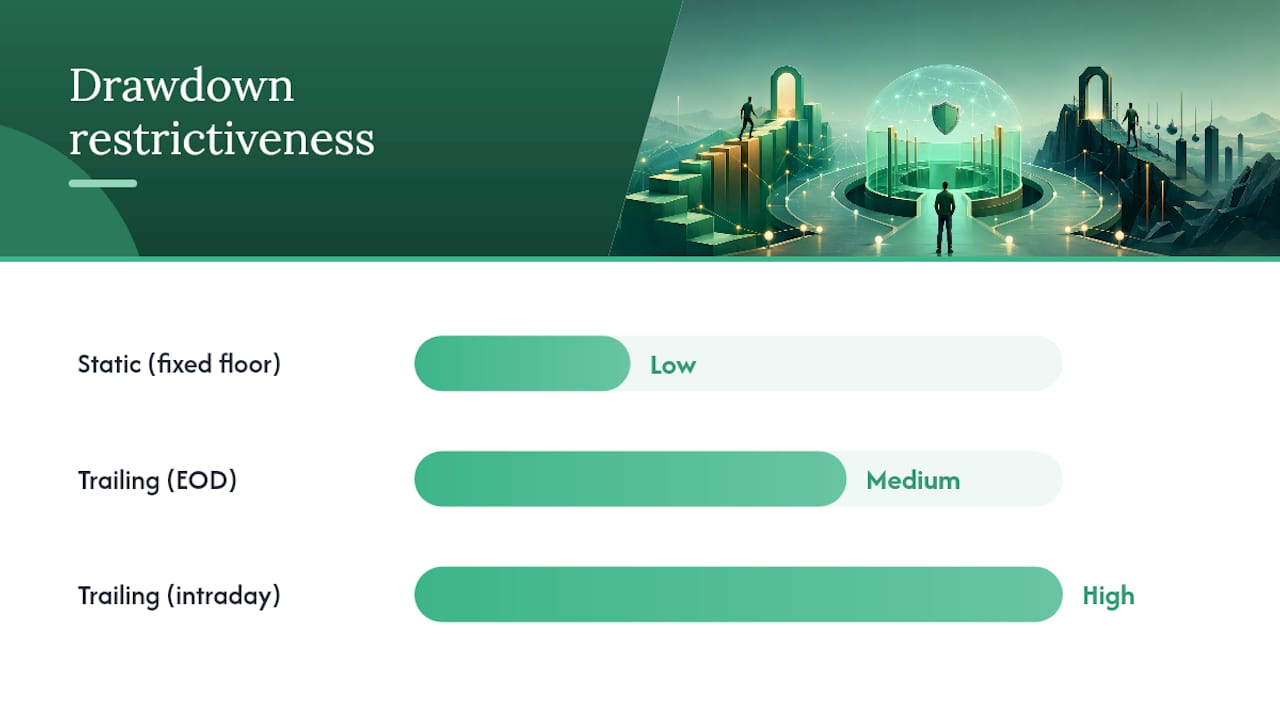
ResponsibleTrading notes say challenge entry costs dey start from around $13 and profit splits fit reach up to 100% depending on the model. This wide range mean say the big numbers no get meaning if you no know the drawdown type wey dey under. 100% split with intraday trailing drawdown hard pass 80% split with static drawdown for most CFD strategies.
Fee math example: $200 entry fee for $10,000 funded account na 2% cost. If you dey expect 30% pass rate for all your attempts, your real cost per funded dollar close to 6.7 cents per $1 of capital. Calculate all these ones join your expected profit before you start.
CFDs legal for US traders so, and which other options dey?
Direct retail CFD trading get restriction for United States. The CFTC and NFA no gree make most US-based brokers offer over-the-counter CFDs to retail clients. This one no be gray area: na real structural restriction wey don dey ground for years, and e dey affect which prop firm accounts you fit legally open and fund.
That said, "CFD prop firm" is a broad label, and not every firm using it is offering products that fall under CFTC jurisdiction. Here is how to think through your options:
- Futures (CME-listed): Fully legal for US residents. ES, NQ, CL, and GC futures dey give you leverage for indices, energy, and metals with full regulatory clear-head. Prop firms wey specialize for Futures na round these instruments dem build dem.
- Forex through regulated US brokers: Spot forex dey available for US residents through NFA-registered brokers, but leverage max na 1:50 for major pairs and 1:20 for minors. Some prop firms dey offer forex-only accounts wey follow this rule.
- Stock CFDs via non-US accounts: Some global prop firms dey offer stock CFDs to people wey no be US account holders. US residents wey try access these accounts through offshore structures dey carry legal and tax risk. This path no be wetin we recommend if you never get better legal advice.
- Listed ETFs and options: For index and commodity exposure, listed ETFs and options for US exchanges na fully compliant alternatives wey dey give you almost the same economic exposure as CFDs.
Practical verification steps for US traders
- Read the firm's terms of service for explicit US residency exclusions. Look for language like "not available to residents of the United States" in the eligibility section.
- Contact support and ask for written confirmation say dem dey accept US traders before you pay any fee.
- E better make you choose firms wey broker-backed or get US-cleared execution if e possible. These structures get higher chance say dem don pass compliance review for US clients.
- Understand your tax reporting obligations. Funded trading profits are generally taxable income in the US, and the treatment varies by instrument. Mixfunded's prop firm tax guide don cover the key reporting levels for funded traders.
Pro Tip: If a firm's terms of service do not mention US residents at all, that silence is not permission. Ask directly, document the response, and keep that record in case of a dispute.
Better look at each prop firm category
Benzinga's use-case picks and PropNavi's trust-based ranking both talk say the best firm depend on your trader profile, no be just one general ranking. See how each category take match wetin traders need.
Mixfunded: marketplace with on-chain payouts
Best for: Low-cost entry, payout transparency, and flexible strategy rules.
Mixfunded dey run evaluations wey start from $5, wey be the lowest entry point for the whole market. Funded accounts dey support MT4 and MT5, dem allow EAs and algorithmic strategies, and no consistency rules or news trading restrictions dey. Payouts na weekly in USDT (TRC-20), wey dem settle on-chain and anybody fit verify am for public payout ledger. Scaling plans reach up to $2M in simulated capital. Make you confirm US eligibility directly with Mixfunded before you enter challenge, because of CFTC restrictions.

Two-phase forex/CFD challengers: FTMO, The5ers, FundedNext
Best for: Traders wey want well-arranged two-phase evaluation with clear records of payment.
FTMO, The5ers, and FundedNext na some of the names wey people dey mention pass for independent reviews. Dem get two-phase evaluations with documented payout histories, MT4/MT5/cTrader support, and profit splits from 75–90%. US eligibility dey different: FTMO get restrictions for US residents on some account types; The5ers and FundedNext get their own policies wey you gats confirm yourself. No assume say any of these firms go gree take US residents for CFD accounts without written confirmation.
Instant-funding providers: BrightFunded, Apex Trader Funding
Best for: Traders wey want sharp-sharp access to funded account without any multi-phase evaluation.
BrightFunded dey give instant-funded accounts without challenge phase, e fit traders wey sure of their game. Apex Trader Funding focus majorly on futures instant-funding, and na one of the best options for US residents wey want fast access without CFD wahala. The two firms get tighter drawdown limits pass two-phase challengers to cover for the easy access.
Broker-backed and subscription firms: Topstep, My Funded Futures
Best for: US residents wey want full regulatory clarity and futures-based instruments.
Topstep and My Funded Futures dey run on subscription models with CME-listed futures. The two dey available for US residents, dem dey use Rithmic and Tradovate for execution, and dem get clear scaling paths. Profit splits na 80–90% after the first payout. These firms na the most straightforward choice for US traders wey no want any CFD eligibility story.
Multi-asset challengers: Funded Trading Plus
Best for: Traders wey want many assets like forex, indices, commodities, and crypto.
Funded Trading Plus offers multi-asset accounts with MT4/MT5 support and profit splits up to 90%. US eligibility follows the same pattern as other global CFD challengers: verify directly before paying. The firm's scaling plan and drawdown rules are published in its rulebook, which is a positive transparency signal.
Pro Tip: Check the PropNavi ranking and LuxAlgo's CFD prop firm comparison side by side. PropNavi weights payout history and regulatory standing; LuxAlgo surfaces user-reported data. Together, they give you a cross-referenced view that neither alone provides.
How do you verify a prop firm's payouts and transparency?
Screenshots of payouts no be proof. Any firm fit post any image dem like. Proper evidence need better standard, and the steps below go show you how to do am yourself.
- Check the public payout ledger. A firm with on-chain payouts publishes wallet addresses and transaction hashes. Copy a transaction hash and verify it independently on a blockchain explorer (e.g., Tronscan for TRC-20 transactions). If the hash resolves to a real transaction with the correct amount and timestamp, the payout is verified. Mixfunded's transparency report dey document this process.
- Cross-reference independent aggregators. PropNavi evaluates firms on operating record, continuous public payout proofs, and regulatory standing. Track360 aggregates on-time payout rates across firms. Use both to cross-check any firm's self-reported payout claims.
- Sample payout cadence. Ask for community forums (Discord, Telegram, Reddit) if payouts dey land for the time dem promise. Look for wetin many traders dey talk, no just follow one person talk. One delay fit be mistake; but if e plenty, na red flag be that.
- Read the terms of service for payout conditions. Some firms include clauses that allow them to delay or deny payouts if they determine a strategy was "exploitative" or violated undisclosed rules. These clauses are a red flag if they are vague or appear only in the fine print.
On-chain payouts in USDT (TRC-20) provide a fundamentally different level of verification than bank transfers or screenshots. Every transaction is timestamped, publicly visible, and immutable. When a firm publishes on-chain proof, you can verify the payout yourself in under two minutes without trusting the firm's word. MixFunded explain how on-chain settlement dey work and why weekly cadence dey reduce the waiting time between your profit and your pocket.
Red flags wey show say payout get wahala:
- Payout delays that exceed the firm's stated timeline by more than 48 hours, repeatedly
- Ledger record wey no tally with the amount wey traders say dem receive
- Terms of service that define "prohibited strategies" after a trader has already passed the challenge
- Support responses that cite "compliance review" without a defined resolution timeline
How we take build this comparison
The shortlist and category comparison for this article, na based on these criteria and sources we take build am:
- Selection criteria: payout reliability (on-time rate and proof wey you fit check), transparency for rules (machine-readable rulebook, no hidden clause), asset and platform coverage, US eligibility document, wetin community dey talk, and their history for the game
- Main sources of evidence: PropNavi's trust-based ranking, Track360's aggregated payout data, TradingPilot's comparison filters, Benzinga's use-case roundup, ResponsibleTrading's fee and split overview, LuxAlgo's CFD prop firm page, and Mixfunded's published transparency materials
- Update style: This comparison na based on data wey dey ground as at mid-2026. Firm rules, fees, and eligibility policy dey change steady. Abeg check their current terms directly with each firm before you put your money.
Wetin many traders dey get wrong when dem dey check prop firms
The thing wey dey always show when traders report bad experience with prop firms no be say dem pick wrong profit split. Na because dem jump the eligibility and payout verification steps because the marketing fine for eye.
Firm fit get fine website, Discord with thousands of members, and 90% profit split, but their payout process fit take six weeks plus three support tickets. The real transparency signals na the "boring" ones: public ledger wey you fit verify yourself, rulebook wey you fit finish once, and payout history wey dey solid for different sources.
For US traders, the CFD eligibility question no be joke. Na him go determine if you fit legally withdraw profit from that account wey you just fund. If you get that answer wrong, you go lose your challenge fee, and maybe more if you don already get profit wey you no fit touch.
Better tip wey you fit use before your first funded account: take your first payout as test, no be jackpot. Request small withdrawal immediately you qualify. If e reach on time through the way dem talk, you don confirm say the process dey work. After that, you fit scale. If e no reach, you don learn important lesson before you put big money for risk.
Mixfunded na transparent starting point for funded traders
If you don dey compare prop firm options and the eligibility questions, hidden rules, plus payout wahala be like obstacle to you, Mixfunded build their system to clear all those stress.

Evaluations start from $5, wey mean say you fit test the process, the platform, and the payout style without to spend big money first. MT4 and MT5 both dey available, we gree for EAs, and consistency rules or news trading bans no dey for here. Payout na weekly for USDT (TRC-20), wey dem settle for on-chain and anybody fit verify am for public ledger with blockchain explorer. Scaling plans reach up to $2M for simulated capital for traders wey dey grow their account steady.
US traders suppose check eligibility for CFD accounts directly with Mixfunded before dem enter challenge, sake of CFTC restrictions on retail CFDs. The Mixfunded Academy also cover tax and reporting matter for funded traders for US.
Start from the funded trading account page to check current evaluation options and see which account types dey allowed for your side.
Sources
- Best Prop Trading Firms — 2026 Trust-Based Ranking | PROP NAVI
- Best Prop Trading Firms 2026: 12 Firms on 10 Criteria
- Compare the Best Prop Trading Firms with TradingPilot
- Best Prop Trading Firms 2026: 12 Firms based on 10 Criteria (Benzinga)
- Best Prop Firms 2026 — Ranked & Reviewed | Responsible Trading