Consistency Rules for Prop Firms: Calculate, Fix, and Avoid Breaches

The consistency rule dey set limit for how much profit you fit make inside one single trading day. If you break am, dem go delay your payout, but dem no go close your account.
Wetyn you need to know sharp-sharp:
- Typical thresholds: 30%–50% of total net profit, but 40% na the most common one across evaluation and payout checks for 2026.
- The result: If you breach am, dem go hold your payout reach when you don make extra small wins to balance the ratio. Your account go still dey open.
- Wetyn to do now-now: Stop to dey request payout. Calculate the extra profit wey you need, then trade to get am with better position sizes.
The rule fit dey at payout stage, evaluation stage, or both, depend on the firm. If you know the stage wey concern you, it go change how you dey plan your trading calendar.
Major Points
The consistency rule is a payout-gating filter, not an account-closing penalty. Knowing the formula and your firm's denominator lets you manage the ratio proactively rather than react to a blocked withdrawal.
| Point | Gbege/Details |
|---|---|
| Original formula | (Best day profit ÷ total net profit) × 100 must stay at or below the firm's threshold. |
| Level wey dem dey set | Many firms dey set their cap between 30% and 50%; 40% na the one wey common pass for 2026. |
| Wetin go happen if you breach | Dem go delay your payout, no be say the money don loss; just trade small-small wins more to reduce that ratio. |
| How to fix the calculation | Total profit wey you need = best day ÷ threshold; minus your current total to see the gap. |
| Mixfunded style | Mixfunded no get any consistency rule for funded accounts, plus weekly on-chain USDT payouts and up to 80% profit share. |
Table of Contents
- How you fit calculate consistency rule for prop firm?
- Examples: person wey pass vs person wey breach and how to fix am
- When and where consistency rule dey follow you?
- Why prop firms dey use consistency rules?
- Wetin you go do after consistency breach: steps to recover
- How to vet a prop firm's consistency rule before you sign up
- How Mixfunded take handle consistency rules
- Wetin trading without consistency rule mean for your mental health
- Mixfunded: funded account wey no need all this consistency calculation
- Consistency rule na for people wey get patience, no be just skill
- Sources
How you fit calculate consistency rule for prop firm?
The di formula wey we dey use na:
Consistency % = (Oga Profit for one day ÷ Total Net Profit) × 100
E must be say your result dey same or e small pass the firm's threshold.
Step-by-step calculation
- Check which day you carry di biggest profit. Na di highest net profit wey you get inside one single day for di time wey we dey check.
- Plus all your total net profit. Add all daily P&L figures for the period. Losing days reduce this number, which is why a single bad week after a big day can make the ratio worse, not better.
- Divide your best day by total net profit. Leave di result as decimal.
- Multiply am by 100 make e for turn to percentage.
- Compare to the firm's threshold. If your percentage pass di cap, dem go gate you reach when you don dilute am.
Special cases wey fit change di math
Na for di denominator many firms dey differ. Some firms compute consistency against positive-days' profit only, meaning losing days are excluded from the denominator entirely. That makes the ratio harder to pass because your total is smaller. Others use gross profit before commissions, or compare your best day against the account's profit target rather than your actual earned profit.
Payout-window resets sef dey matter. Many firms dey reset di consistency clock after every withdrawal wey dem approve, so di counting dey start fresh. If your firm dey reset, one big day for di beginning of new window dey dangerous pass dat same big day for di end of window when you don already get many small wins.
Online consistency calculators typically ask for three inputs: best-day profit, total profit, and the firm's threshold. They return your current percentage and the additional profit needed to reach compliance. Running the numbers before you request a payout takes about 30 seconds and can save you weeks of waiting.
Examples: person wey pass vs person wey breach and how to fix am
Example 1: $1,500 best day, 50% threshold
- Best day: $1,500
- Total net profit: $4,000
- Consistency %: ($1,500 ÷ $4,000) × 100 = 37.5%
- Result for 50% threshold: Pass
- Result for 30% threshold: Rule break
Example 2: $2,000 best day, 40% threshold
- Best day: $2,000
- Total net profit: $4,500
- Consistency %: ($2,000 ÷ $4,500) × 100 = 44.4%
- Result for 40% threshold: Rule break
How to fix am: Profit wey you need = Best day ÷ Threshold
For Example 2: $2,000 ÷ 0.40 = $5,000 na total profit wey you need
You get $4,500 now, so you need extra $500 net profit from small-small consistent days before you fit request payout. The calculation simple, any trader fit do am for spreadsheet.
Threshold comparison for $2,000 best day
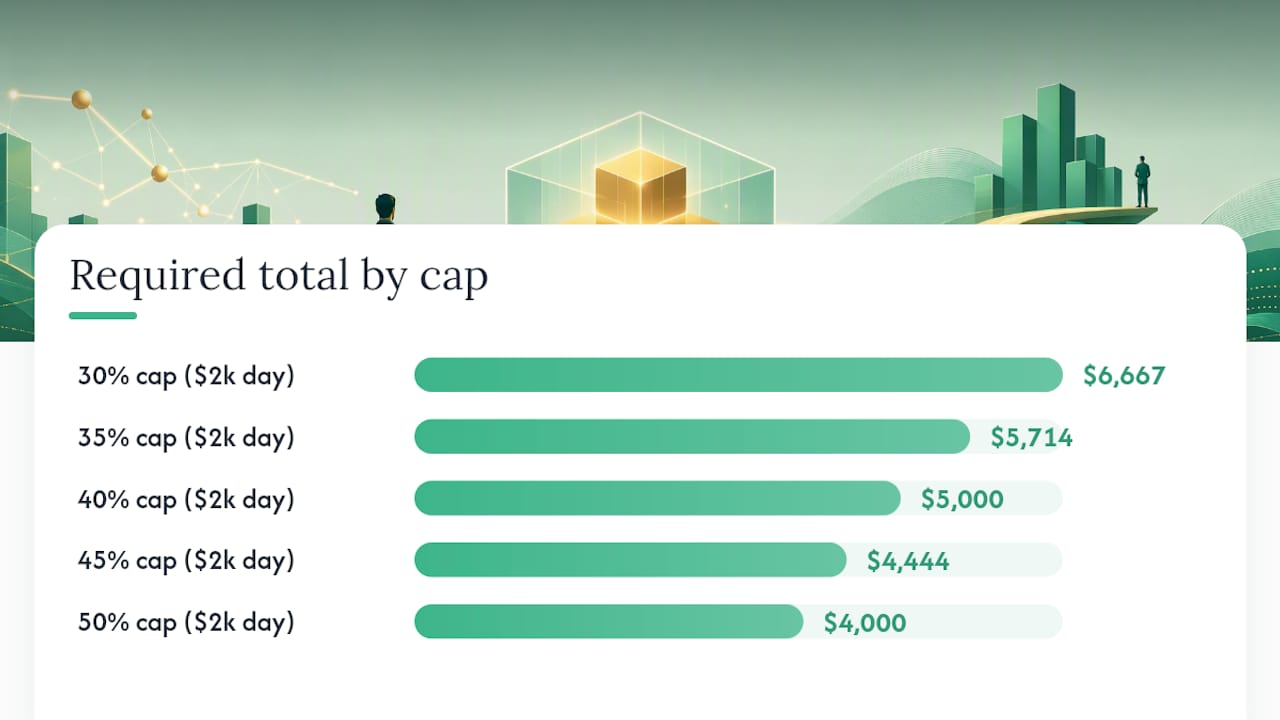
E go need four times the total profit to clear that same best day. That gap dey wide fast-fast when your best day big pass normal.
Quick ways to fix am if you don dey near the limit:
- Wait small before you request payout; make more trading days join body.
- Add small-small wins for many sessions to make the total big.
- Abeg no go do high-conviction, over-sized trades until the ratio drop well-well below the cap.
- Use risk calculator take size your positions so that no single day go fit carry your total profit run again.
When and where consistency rule dey follow you?
Prop firms different well-well for which stage dem dey check consistency. E make sense make you sabi when dem dey check am as you sabi the formula.
Common places dem dey apply am:
- During evaluation challenge: Some firms dey check consistency for the end of challenge phase. If your best day big pass your total challenge profit, dem fit fail you once or dem go tell you make you continue to trade before you pass.
- When you wan collect payout: Naim common pass. The firm dey calculate am when you request for withdrawal. If you break the rule, dem go hold your payout reach when you don balance the ratio.
- For funded accounts: Some small-small firms dey carry the rule enter funded phase. This one na the hardest one because e dey affect real profit split, no be just to pass evaluation.
Other styles outside the percentage cap:
- Minimum days wey you get profit: Some firms go want make you get minimum number of profitable trading days (like 3–10 active days), no be just percentage cap. The result na the same thing but the math different.
- Single-trade caps: Some few programs dey limit how much profit one single trade fit give you, no matter the daily total.
- Best-day-only checks: The firm dey look whether any single day pass one fixed dollar amount, no be the ratio.
After dem don approve your payout, many firms dey reset the consistency window. Your next measurement period go start fresh, which mean say the first few days of the new window get high risk. Plan your big trades for mid-window, after you don build base with small-small profit sessions.
Why prop firms dey use consistency rules?
From the firm's perspective, consistency rules are underwriting filters. Before paying out a profit split on simulated capital, the firm wants evidence that the performance is repeatable, not a single lucky trade that happened to hit during the evaluation window.
One big day dey look like luck for outside eye. Firm no fit tell the difference between trader wey catch news spike for one position and trader wey get discipline across many sessions. The consistency rule dey force you to show say you sabi the work before dem approve payout.
This logic dey follow how the rule dey work with other protections. Drawdown limits dey cover the downside. Minimum trading-day requirements dey prevent traders to pass for one session. The consistency rule dey handle the upside: e dey prevent trader to pass for one over-size day. Together, these rules dey create performance profile wey look like real work, no be just gambling.
U.S. traders suppose also know say payout mechanics and contract disclosures dey follow regulatory obligations when you dey trade regulated instruments. The NFA's disclosure materials make sense make you check am join any funded account agreement to understand how contract-level terms take concern your situation.
Wetin you go do after consistency breach: steps to recover
If you break the rule, no be wahala. Na math problem wey get solution. See the structured recovery plan for here.
- Stop all payout requests sharp-sharp. To submit withdrawal when you don breach na waste of time and some firms fit even start to look your matter with manual review.
- Run the fix formula. Divide your best day by the threshold to find the total profit wey you need. Subtract your current total to see the gap wey remain.
- Set daily profit target for the recovery period. Divide the gap by the number of trading days you plan to use. Keep each day's target well below the consistency cap so no new day becomes the new "best day."
- Trade with small position sizes. This no be time to dey carry high-risk setups. Target small-small wins wey you fit repeat.
- Dey track your ratio every day. Recalculate after every session. You gats see the percentage as e dey drop small-small.
- Submit for payout only when you don dey far below the threshold. "Comfortably" means at least 3–5 percentage points of buffer, not right at the line.
- Contact support if the breach no too clear. If you believe the firm's calculation is using a denominator you did not expect (positive-days only vs. net profit), ask for clarification in writing and keep a record.
Pro Tip: Set a personal consistency cap 5–10 percentage points tighter than the firm's official threshold. That buffer absorbs a strong day without triggering a gate.
To break consistency rule na soft breach normally: dem go hold profits, dem no go seize am. Traders fit get back their eligibility if dem fit trade more and get extra profit wey go bring down the best-day share. The recovery time depend on how big the gap be and how you fit take dey get small-small wins consistently.
How to vet a prop firm's consistency rule before you sign up
To read the rulebook before you fund account na the biggest risk-management step wey you fit take. See wetin you go look for.
Vetting checklist:
- The exact threshold percentage. E be 30%, 40%, 50%? Get the real number, no follow vague talk.
- The denominator wey dem use. Net profit, positive-days profit, or profit target? This one fit change the calculation well-well.
- The stage(s) where e apply. Evaluation only, payout only, or both? E dey follow reach funded accounts?
- Wetin dey happen when you reset. E dey reset after every payout wey dem approve? Or na after some days?
- Old rules vs new account rules. The levels fit change. Some firms don change levels (like the one for early 2026 wey affect old and new accounts), so confirm the one wey apply to your own account.
Red flags wey you gidi look:
- Vague wording like "reasonable consistency" with no defined percentage.
- Difference between wetin dey help center and the real Terms and Conditions document.
- Dem no talk wetin go happen to your profit if you break rule (dem go hold am, collect am, or just delay am?).
- Changing rules anyhow without protecting people wey don open account before.
Sample phrases to search in the firm's T&Cs:
- "best day," "single day," "daily profit cap"
- "consistency percentage," "consistency ratio"
- "payout eligibility," "withdrawal conditions"
- "positive trading days," "minimum trading days"
Performance tracking tools like Ciphora can help you monitor your daily P&L distribution and flag when a single session is starting to dominate your running total, before you hit the firm's threshold.
How Mixfunded take handle consistency rules
MixFunded no get consistency rule for funded accounts. We do am on purpose, and e dey help you trade well and collect your money fast.
Wetin MixFunded dey offer:
- No consistency requirement for funded accounts. One big day no go block your payout.
- Challenge entry from $5, e dey easy for traders wey wan test their levels without to spend big money.
- Weekly payouts in USDT (TRC-20) for public on-chain ledger, so every transaction dey transparent and verifiable.
- Up to 80% profit share on funded account earnings.
- MT4/MT5 compatibility and support for EAs and flexible strategies, join news trading join.
- Scaling plans reach up to $2 million for simulated capital for traders wey sabi dia work.
The public payout ledger na serious signal for trust. You fit check say payouts dey happen before you even start your challenge.
As with any funded program, read the full Terms and Conditions before trading. Mixfunded's trading rules page lists all current requirements in plain language. U.S. traders evaluating any funded account that involves regulated instruments should also review the relevant NFA disclosure materials alongside the firm's contract.
Wetin trading without consistency rule mean for your mental health
Comot the consistency rule go change how you dey view your best days. Under that ratio system, one big win go create problem: e go raise the bar for everything wey follow. Traders dey always talk say dem dey pull back after big day, no be say market no good, but na because dem dey manage math problem instead of to trade dia edge.
That behavioral wahala na real tin wey people no dey value. How you take size position, pick trade, and time your session, everything go just bend follow that consistency calculation instead of market opportunity. Firm wey comot that rule don allow you trade the market as e dey show.
Mixfunded: funded account wey no need all this consistency calculation
If na consistency rule dey pain you pass for prop trading, Mixfunded na the place. The funded trading account starts from $5 to enter, e dey pay weekly in USDT for public blockchain, and no consistency requirement for funded accounts. Your best day na just your best day.

The challenge programs are designed to evaluate real trading skill without layering in rules that penalize strong performance. Check the current program options and entry costs at Mixfunded's challenges page, and verify the full rulebook before you start.
Consistency rule na for people wey get patience, no be just skill
The normal advice on consistency rules na just for the math: calculate your ratio, find the gap, and trade am down. That advice dey correct but e never complete.
Wetyn many people no dey talk be say consistency rule na behavioral test wey dem hide inside arithmetic. The firm no just dey check number. Dem dey check if you sabi say one big session no mean say you don get edge wey go last.
The traders who handle consistency rules best are the ones who never let the ratio get close to the cap in the first place. They size positions so that even their best day lands well inside the threshold. They treat the consistency percentage as a live metric, not an afterthought before a withdrawal. That discipline compounds over time in ways that pure P&L management does not.
Where the conventional advice genuinely falls short is in explaining what to do when the rule itself is poorly designed. Opaque denominators, retroactive threshold changes, and inconsistencies between a firm's help center and its T&Cs are not edge cases. They happen. The right response is not to accept the ambiguity but to ask for written clarification before you trade, not after a payout is blocked.
If firm no fit explain dia own consistency rule in plain grammar, that one don tell you how dem go take handle wahala if e sup.
Sources
- Consistency Rule Explained: How One Big Day Fit Block Your Payout | PROP NAVI
- Wetin Be Consistency Rule for Prop Firms? (2026 Guide) | PropFirmPickr
- Consistency Rule Explained: Prop Firm Limits & Calculator
- Prop Firm Consistency Rule Definition, Types and Examples
- Wetin Be Consistency Rule for Prop Firms: Sabi Am Before E Cost You Better Money
- Nfa
Cross-check any specific percentage against the firm's own help center or Terms and Conditions before relying on it. Thresholds change, and the version that applies to your account may differ from what a third-party guide reports.