Pass Prop Firm Challenge: Risk-First 30–50 Day Plan

To pass a prop firm challenge reliably, treat the evaluation as a risk-management exam, not a profit race. Your edge matters less than your ability to protect capital while accumulating gains within the firm's ruleset. Most traders fail due to drawdown and daily-loss breaches, not because they lack a working strategy. That single fact should shape every decision you make from day one.
Three things wey you must do for your first day:
- Read the firm's full terms and conditions and extract four numbers: profit target, daily loss limit, maximum drawdown, and minimum trading days.
- Set personal daily and maximum drawdown buffers that are stricter than the firm's limits, not equal to them.
- Calculate every trade make you risk 0.5–1% of the account, and no change am until you don get at least ten sessions of correct data.
The firm's limits are the floor, not your operating target. Traders who treat a 5% daily loss cap as their personal stop are one bad session away from a breach. Your internal limit should sit at roughly 50% of the firm's daily loss cap before you ever place a trade.
Pro Tip: Write your three 'must-obey' rules for paper before you open platform: your session time, maximum trades per session, and your risk-per-trade. Take dem as law, no be suggestion.
Table of Contents
- Wetin you suppose do before you pay for prop firm evaluation?
- How prop firm evaluation rules self take dey work?
- How you go take set position size for $25k, $50k, and $100k accounts?
- Wetin your strategy suppose look like for each phase of the challenge?
- Wetin be the main things to track for your trade journal?
- Your 30–50 day plan to pass the challenge sharp-sharp
- How you go take choose the right firm wey go fit your trading style?
- How does Mixfunded's model align with passing the challenge?
- Wetin you go do after you pass? Submission and onboarding checklist
- How real challenge journey dey look: two common scenarios
- Major Points
- Wetim traders wey dey always get funding dey do different
- Mixfunded dey give you clear road wey no cost to get funded account
- Other things to read and where we see them
Wetin you suppose do before you pay for prop firm evaluation?
If you skip this checklist, you fit pay twice. Make you finish everything before you buy.
- Comot the four main numbers. Read the actual T&Cs, not a summary page. Pull out the profit target percentage, daily loss limit, maximum drawdown, minimum trading days, and any consistency rule. Some firms' funded-phase rules differ from the evaluation phase, so read both.
- Run a demo under the firm's exact ruleset for 2–4 weeks. Follow the challenge rules exactly: same account size, same daily cap, same drawdown limit. If your strategy no fit hit the profit target for demo without breaking rules, e no go work for live.
- Calculate your position size and set your own limits. Your personal daily stop should sit at roughly 50% of the firm's daily loss cap. Traders wey don tey for the game dey always recommend this buffer to absorb variance without touching the firm's hard limit.
- Pick one market, one session, and one main setup. If you focus on one thing before Day 1, you no go dey confused during the challenge. When you no too get many decisions to make under pressure, you no go too make mistake.
- Set your tools ready. At minimum: get trade journal wey you go dey write your feelings, real-time drawdown monitor, and pre-trade checklist wey you go dey check before every session.
Pro Tip: Check whether the firm's drawdown is calculated from your starting balance, your peak equity, or your end-of-day equity. That single distinction changes your entire intraday risk model.
How prop firm evaluation rules self take dey work?
How you take dey move for each phase and how your strategy take follow the rules na him go make you pass well. Before you start to dey pace yourself, you need to understand wetin each rule dey check and how e fit carry you comot for game.
Consistency rules and minimum trading days
Some firms cap how much of your total profit can come from a single day, often 30–40% of the overall target. If your profit target is $8,000 and the consistency cap is 30%, no single day's gain can exceed $2,400. A trader who hits $5,000 in one session may technically be close to the target but still disqualified.
Minimum trading days na another trap. If the firm say you must trade for 10 days and you reach profit target for Day 6, you must still trade for four more days without breaking any rule. To finish fast no be always better thing. The first two trading days na when people dey pass their limit pass as traders dey over-trade because of excitement. If you slow down for start, you dey protect your account when e still dey vulnerable.
News and overnight rules
Boku firms dey restrict trade during high-impact news or dem no dey gree make you hold position overnight. Abeg check di news trading policy before you build your strategy. Setup wey based on news fit work for standard account but dem fit ban am for evaluation.
Beta logic: Firms dey set dis rules to test if you fit manage risk even when things tight. If you sabi how prop firms take dey make money e go clear you why dem set di rules like dat.
How you go take set position size for $25k, $50k, and $100k accounts?
How you take dey size your position na di main koko to survive challenge. Di formula simple die:
Position size = (Account balance × Risk per trade %) ÷ Stop distance in dollars
For forex example: for $50,000 account wey dey risk 0.5% with 20-pip stop for EUR/USD (pip value ≈ $10 per standard lot):
- Dollar risk = $50,000 × 0.005 = $250
- Lots = $250 ÷ (20 pips × $10) = 1.25 lots
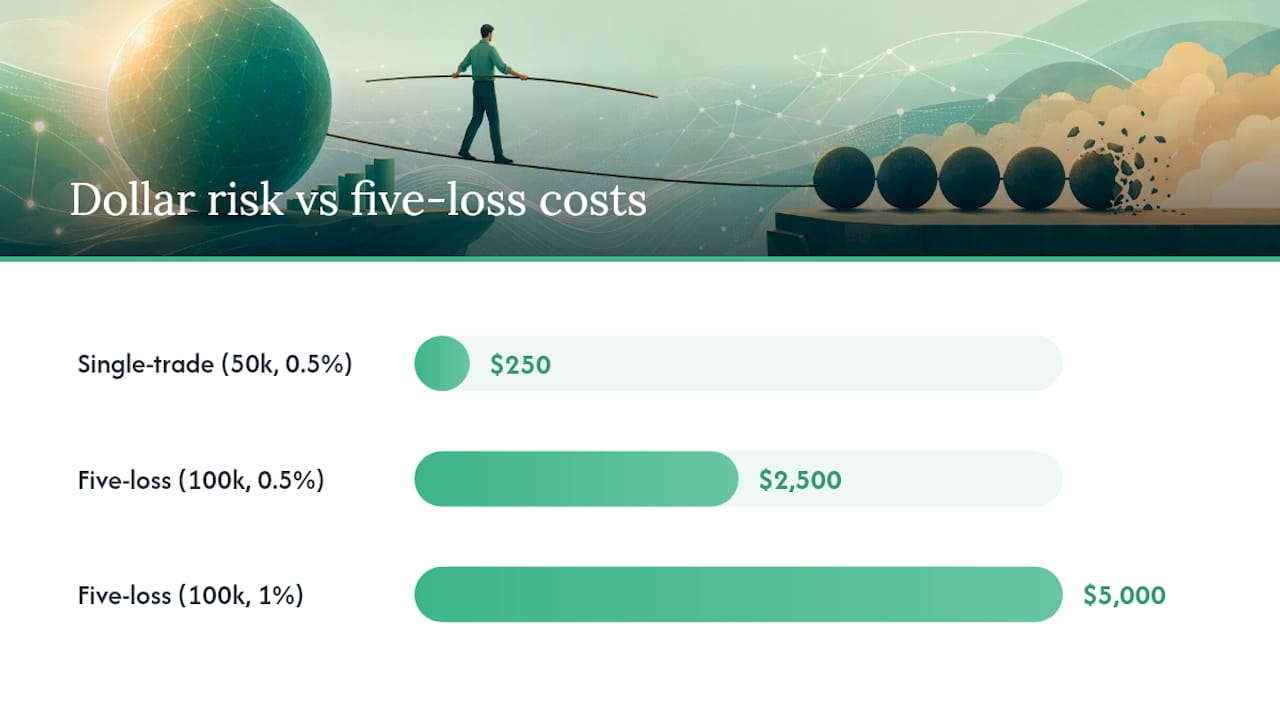
Di table for down show how risk-per-trade dey affect different account sizes and wetin five-loss streak go cost you relative to 10% maximum drawdown.
| Account | Risk/Trade | $ Risk | 5-Loss Streak | Max Drawdown Used |
|---|---|---|---|---|
| — | 0.5% | — | — | — |
| — | 0.5–1% | $250 | — | — |
| $50,000 | 0.5% | $250 | — | — |
| $50,000 | 0.5–1% | — | $2,500 | — |
| $100,000 | 0.5% | — | $2,500 | — |
| $100,000 | 0.5–1% | — | $5,000 | — |
At 1% risk per trade, five losses back-to-back for $100,000 account go chop exactly half of your maximum drawdown. At 0.5%, di same streak go only chop quarter. Dat space na wetin go keep you for game reach when you go recover and hit profit target.
Daily-loss budgeting works the same way. If the firm's daily cap is 5% ($5,000 on a $100,000 account) and your personal limit is 50% of that ($2,500), you can absorb five 0.5%-risk losses before hitting your personal stop. That is a realistic bad day, not a catastrophic one.
Pro Tip: For your first 3–10 sessions, trade at 50% of your intended size. Use that period to validate that the live conditions match your demo results. Scale only after you have confirmed your edge is intact under the firm's actual rules.
Use Mixfunded's risk calculator and drawdown simulator sharp your eye with these scenarios before you ever open any position.
Wetin your strategy suppose look like for each phase of the challenge?
Most traders wey dey pass dey use like 2–6 weeks if dem target 0.5–1% everyday. The koko be say make you adjust your lifestyle as the account dey waka through three levels.
Phase 1: Early orientation (0–40% of profit target)
Your only goal in this phase is to confirm that your setup works under the firm's live conditions. Trade at 50–75% of your intended size. Take only your highest-conviction setups. Do not chase missed moves. If you breach your personal daily limit on any day in this phase, stop immediately and review before the next session.
Phase 2: Mid-challenge survival (40–80% of profit target)
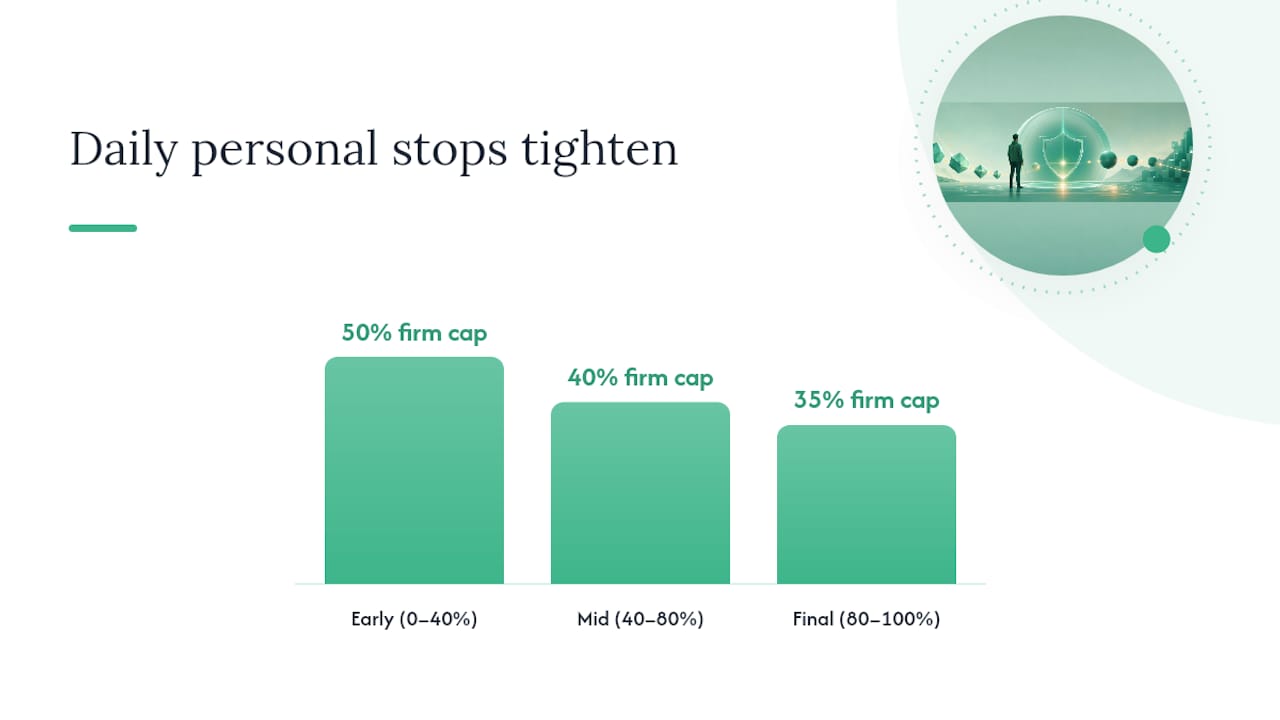
You have validated your edge. Now the priority shifts to protecting the buffer you have built. Maintain your standard risk-per-trade but tighten your daily stop to 40% of the firm's cap instead of 50%. Avoid adding new instruments or setups. This is not the phase to experiment.
Phase 3: Final stretch (80–100% of profit target)
Reduce your size to 50–75% of your standard risk-per-trade. You need small-small, steady wins to cross the line without risking any late-stage wahala. One bad day with full size fit wipe out one week of better work.
| Phase | Profit Progress | Risk/Trade Target | Daily Stop (Personal) | Priority |
|---|---|---|---|---|
| Early | 0–40% | 50–75% of normal | 50% of firm cap | Validate edge |
| Mid | 40–80% | 100% of normal | 40% of firm cap | Protect buffer |
| Final | 80–100% | 50–75% of normal | 35% of firm cap | Close safely |
75% checkpoint: If you don reach 75% of your profit target, check your drawdown well well. If you don use pass 40% of your max drawdown, sharp-sharp reduce your size and no increase am again.
90% checkpoint: Once you reach 90% of your target, switch to the smallest position size possible. The calculation simple: if you fail here, your evaluation fee don go. But if you take two extra days finish am safely, you no lose anything.
Wetin be the main things to track for your trade journal?
Journal only make sense if e dey help you make decision. Track all these things for every trade:
- Time, instrument, and session (London, New York, overlap)
- Setup tag (e.g., "trend pullback," "range breakout")
- Entry price, stop price, and target price
- Dollar risk for the trade
- How you dey feel (calm, anxious, frustrated, confident)
- Outcome: win/loss, actual R wey you get
Aside individual trades, dey monitor these live metrics every session:
- Peak equity and your current drawdown from peak
- Daily P&L versus your personal daily cap
- Losses wey follow each other for the current session
- Realized versus unrealized equity (no count open positions join your profit target)
- Profit-target progress as percentage
The weekly review table for bottom show the levels wey suppose make you change rules.
| Metric | Review Trigger | Action |
|---|---|---|
| Drawdown wey you use | >40% of max drawdown | Reduce size by 50% |
| Daily cap don hit | Personal limit don reach | Stop trading for the day |
| Consecutive losses | 2 for one session | Stop trade sharp-sharp |
| Win rate (weekly) | Below 40% | Pause and do paper trade |
| Profit progress | >90% of target | Change to minimum size |
Emotional-state tracking in journals provides objective triggers to stop trading and prevents the behavioral drift that causes late-stage failures. When your journal shows three consecutive "frustrated" tags before a loss, that pattern becomes a rule: frustrated = no trade.
Use the Mixfunded Academy for structured guidance on reading challenge rules and building a journal framework that maps to the firm's exact ruleset.
Your 30–50 day plan to pass the challenge sharp-sharp
-
Days 1–3 (Orientation). Trade with 50% of the size you plan use. Only take your main setup. Record every trade with complete journal details. No try chase profit yet. Goal: confirm say live conditions match your demo results.
-
Days 4–10 (Validation). Increase am to 75% of your size if Days 1–3 no get any rule breach and your setup work as e suppose work. Check your journal everyday. Check your drawdown usage every morning before you start trade.
-
Days 11–20 (Standard execution). Trade with full size (0.5–1% per trade). Follow the phase-based rules from Section 5. Use the two-loss rule every session, no stories.
-
Days 21–30 (Mid-challenge review). Do full journal review. Calculate your profit progress, drawdown usage, and win rate. If any metric no dey okay, reduce size and do paper trade for two sessions before you come back.
-
Days 31–40 (Final stretch). If you don reach 80%+ of the profit target, change to 50–75% of your normal size. Track your minimum trading days. No add new setups or instruments.
-
Days 41–50 (Close safely). Minimum size only. One setup, one session per day. Stop the very moment you hit the profit target and you don complete the minimum trading days.
Conditions wey go make you stop:
- If you hit your personal daily limit: stop trade for that day, no story.
- If your drawdown pass 60% of max: cut your size by half, no increase am till you finish challenge.
- If your win rate fall below 40% for any 10-session window: pause the challenge, go practice for demo for one week before you start again.
- If you hit your personal daily stop two times back-to-back: check weda your strategy still dey work with how market be before you continue.
Daily routine:
- Before session: check your drawdown floor, set your position size, mark news events, and look your journal for the last session.
- Inside market: stop trading if you loss two times back-to-back; stop if you hit your personal daily limit.
- End of day: log all trades with emotional tags, update profit-target progress, calculate next session's drawdown floor.
How you go take choose the right firm wey go fit your trading style?
The right challenge is the one whose rules match your proven edge, not the one with the most attractive marketing. Verify the firm's rules before paying, and use this criteria checklist when vetting any firm's T&Cs.
Criteria checklist:
- Which type drawdown dem dey use: static, intraday trailing, or EOD trailing?
- The daily loss limit, na from starting balance or current balance dem dey calculate am?
- Consistency rule dey? And wetin be the percentage cap per day?
- Wetin be the minimum trading days wey dem want?
- Dem dey allow EAs and robots?
- Dem dey allow news trading and to hold trade overnight?
- Wetin be the time limit to finish the evaluation?
- The rules for funded-account and evaluation, dem different?
Use the Mixfunded vetting guide take run this checklist against any firm before you commit your money.
| Trading Style | Best Drawdown Type | Consistency Rule | EA Policy | News Trading |
|---|---|---|---|---|
| Swing trader | Static or EOD trailing | Flexible or e no get | E no too mata | Abeg avoid am |
| Scalper | Static | Flexible or e no get | E go beta | Abeg avoid am |
| News/macro trader | Static | Flexible or e no get | E no too mata | E must dey allowed |
| Algo/EA trader | Static or EOD trailing | Flexible or e no get | E must dey allowed | E depend on the firm |
Swing traders na dem dey suffer pass for intraday trailing drawdown because positions wey don enter profit before e reverse fit lock their floor permanent. Scalpers need tight spreads and static drawdown so small small fluctuations for market no go move their floor. Algorithmic traders must confirm if EA dey allowed for writing before dem pay, because some firms dey restrict automation to specific hours or dem go ban am kpatakpata.
How does Mixfunded's model align with passing the challenge?
Mixfunded's product design maps directly to the pass-framework described throughout this guide. Here is how each feature connects to a concrete tactic.
- Rules wey clear and open. Mixfunded dey publish their full trading rules without any hidden corner-corner. That transparency dey make pre-challenge checklist fast to complete because na the real rules you dey read, no be just marketing wash.
- Weekly USDT (TRC-20) payouts with on-chain transparency. Every payout dey public and clear for the Mixfunded ledger. That transparency na big trust signal when you dey decide if firm go actually pay you after you pass.
Pro Tip: Use Mixfunded's risk calculator make you run the position-sizing worksheet from Section 4 against your specific account size and stop distances before day one. E no go pass five minutes and e go remove all the 'I guess' from your sizing decisions.
Wetin you go do after you pass? Submission and onboarding checklist
To pass evaluation na specific moment with specific steps. No skip any of dem.
Submission checklist:
- Confirm say you don hit profit target and minimum trading days at the same time.
- Verify no rule was breached at any point during the evaluation (check the platform's rule tracker, not just your journal).
- Close all your trades before you submit. No carry trades enter the funded account if the firm never give you permission.
- Take screenshot or export your full trading history, equity curve, and rule-compliance report.
- Submit the evaluation through the firm's official process and retain the confirmation.
Onboarding checklist:
- Read the funded-account T&Cs separately from the evaluation T&Cs. Rules often differ between phases.
- Confirm the payout schedule, payout method, and profit split percentage for writing before you place your first funded trade.
- Set up your funded account with the same internal limits you use during evaluation. No go increase risk just because you don get funding.
- Check the drawdown type for the funded account. Some firms dey change from static to trailing drawdown after evaluation.
- Schedule your first payout request according to the firm's minimum holding period.
- Keep your trade journal moving from day one for the funded account. Na that same discipline wey make you pass evaluation go keep the account alive.
How real challenge journey dey look: two common scenarios
These scenarios show where traders dey succeed or fail. We build them from behavioral patterns inside this guide, no be for any particular person.
Scenario A: The controlled pass
A trader with a trend-pullback strategy on EUR/USD starts a $50,000 evaluation. Days 1–3 are at 50% size, producing three small winning sessions and one small loss. No rule is touched. By day 10, the account is at 35% of the profit target. The trader increases to full size (0.5% per trade) and maintains the two-loss rule strictly. On day 18, a frustration tag appears in the journal after a losing session. The trader stops for the day at the personal daily limit, not the firm's limit. By day 28, the profit target is reached with 60% of the maximum drawdown unused. The trader reduces to minimum size, completes the minimum trading days on day 32, and submits.
Wetin make am work: the slow start for beginning, the journal stop on top frustration day, and the size reduction when e reach 80% of target.
Scenario B: The avoidable reset
One trader start $100,000 evaluation with scalping strategy. Day 1 sharp well, so the trader double size for day 2 because e get confidence. News spike for day 3 trigger 3% loss for one session, and 60% of maximum drawdown finish in three days. The trader try to recover by increasing size more. By day 5, e don breach maximum drawdown and evaluation don end.
The failure no get anything to do with strategy. E happen because the trader ignore slow-start rule, skip news calendar, and troway the position-size discipline wey work for demo. Every single error for there, e for fit avoid am.
Major Points
Passing a prop firm challenge comes down to one discipline: protect capital first, accumulate profit second, and never treat the firm's hard limits as your personal operating targets.
| Point | Gbege/Details |
|---|---|
| Risk-first execution | Size every trade at 0.5–1% of the account and set personal daily stops at 50% of the firm's cap. |
| Sabi your drawdown type | Static, intraday trailing, and EOD trailing—each one get different risk model—confirm your own before day one. |
| Phase your approach | Trade 50–75% size for start, full size for middle, then reduce am again for the last lap. |
| One setup, one session | If you stick to your best setup and session, you go avoid wahala and rule conflicts throughout the evaluation. |
| Mixfunded's fit | Mixfunded's no-consistency-rule, EA-allowed, on-chain payout model removes three of the most common disqualification triggers. |
Wetim traders wey dey always get funding dey do different
The difference between traders wey dey pass once and those wey dey pass every time no big as people think. No be say their strategy better pass. Na because dem treat the evaluation as special environment with rules, and dem no dey let normal trading habits mess am up.
The two-week demo validation rule is where most serious traders draw the line. If a strategy cannot produce consistent results on a demo running the firm's exact ruleset for two weeks, it is not ready for a paid evaluation. That sounds obvious. Most traders skip it anyway because they are confident in their live track record. The problem is that live trading and challenge trading are not the same activity. The rules change the math, and the math changes the behavior.
Journaling is the other separator. Not because writing things down is inherently valuable, but because a journal with emotional-state tags converts subjective feelings into objective data. When you can see that your worst sessions consistently follow a "frustrated" or "overconfident" tag, you have a rule: those states mean no trade. That rule is worth more than any technical setup.
The traders who pass consistently are not the ones with the best entries. They are the ones who stop when they are supposed to stop, size correctly from session one, and treat the evaluation's rules as non-negotiable constraints rather than guidelines to bend when conditions feel right.
Mixfunded dey give you clear road wey no cost to get funded account
If the way wey this guide talk match how you wan trade, MixFunded build their system on top the same thing. Challenges start from $5, the rules dey clear without hidden wayo, and every payout dey recorded on-chain so you fit verify am yourself. No consistency rule for here and no news trading ban. EAs dey allowed, so you fit automate your daily-loss shutdown and position-size cap wey this guide talk about.

The funded trading account options scale from entry-level to $2 million, and weekly USDT payouts mean say you no go wait one month before you see results. View the full challenge programs and test your sizing options for the risk calculator before you start.
Other things to read and where we see them
- Pass prop firm challenge — TradeZella
- How to Pass a Funded Challenge in Under 50 Days — RB Trading
- How to Pass a Prop Firm Challenge — PropFirmApp
- How to pass a prop firm challenge — FundedTraderIntel
- How to Pass a Prop Firm Challenge — TradingToolsHub
- How to Pass a Prop Firm Challenge: 10 Proven Strategies — ThePropFirmGuide
- How to Pass a Prop Firm Challenge — FundedWiki
- How to Pass a Funded Challenge Without Blowing It — R2F Trading