CFD Prop Firms for US Traders: Compare Fees, Rules, Payouts

For US traders, the clearest starting point is a marketplace model that offers on-chain payouts, transparent rules, and confirmed US eligibility. Marketplaces like Mixfunded fit that profile: evaluations from $5, weekly USDT (TRC-20) payouts verified on-chain, and MT4/MT5 compatibility. Two-phase global challengers with documented payout records are a solid second tier, but US eligibility for CFD accounts must be confirmed for each firm. Futures-specialist firms are the most straightforward option for traders who want CME-listed instruments and full US regulatory clarity, and are the only category fully available to US residents without CFD ambiguity.
Before you pay any challenge fee, check one critical fact: the CFTC restricts retail CFD trading in the US. Most prop firms that offer CFD accounts serve non-US residents or route exposure through instruments that fall outside CFTC jurisdiction. Confirm your eligibility in writing before you enter.
Here is a quick-reference shortlist by category:
- Marketplace with on-chain payouts (recommended for US traders who qualify): low entry cost, public payout ledger, flexible strategy rules
- Two-phase global CFD challengers: established payout histories, strong platform support, but US eligibility varies by firm and often restricts CFD accounts for US residents; confirm eligibility in advance
- Futures-specialist firms: CME-based instruments, fully compliant for US residents, no CFD ambiguity
Pro Tip: Before comparing profit splits, confirm whether the firm explicitly accepts US residents for CFD accounts. A 90% profit split means nothing if you are ineligible to withdraw.
Key Takeaways
For US traders, the most important step before paying any challenge fee is confirming CFD eligibility in writing, because CFTC restrictions mean many global prop firm accounts are not legally accessible to US residents.
| Point | Details |
|---|---|
| Confirm US eligibility first | Ask firms directly whether US residents can open and withdraw from CFD accounts before paying any fee. |
| Verify payouts independently | Use on-chain transaction hashes and aggregator data from PropNavi and Track360, not screenshots alone. |
| Match drawdown type to your strategy | Static drawdown is more predictable; trailing intraday drawdown is the most restrictive for active CFD traders. |
| Futures are the clearest US-compliant path | CME-listed futures through firms like Topstep or My Funded Futures carry no CFD eligibility ambiguity for US residents. |
| Mixfunded offers low-cost, transparent entry | Evaluations from $5, weekly on-chain USDT payouts, and a public ledger make Mixfunded a verifiable starting point. |
Primary sources and references
- PropNavi trust-based ranking: operating record, payout history, and regulatory standing scores for prop firms
- Track360 aggregated payout data: on-time payout rates and firm-level comparisons (Q2 2026)
- TradingPilot comparison filters: side-by-side fee, drawdown, and payout term comparisons
- Benzinga prop firm roundup: use-case picks and core decision factor analysis
- ResponsibleTrading overview: entry fee ranges and profit split benchmarks
- LuxAlgo CFD prop firm page: user query data and firm comparison listings
- Mixfunded transparency report: public payout ledger and on-chain settlement documentation
- Mixfunded payout explainer: on-chain USDT settlement process and weekly cadence details
A note on aggregator rankings vs. firm-published payouts: Aggregator rankings like PropNavi and Track360 weight independent evidence over firm self-reporting. When a firm's published payout stats differ from aggregator data, treat the aggregator figure as the more conservative and reliable estimate.
This article provides general information about prop trading firms and is not financial, legal, or tax advice. Confirm current rules, eligibility, and tax obligations with the relevant firm and a qualified professional before committing capital.
This article is general information, not a substitute for advice from a qualified financial advisor. Consult a qualified financial professional about your own circumstances before acting on anything here.
Table of Contents
- Which CFD prop firm categories work for US traders?
- How do you choose the right CFD prop firm?
- What evaluation model fits your trading style?
- Are CFDs legal for US traders, and what are the alternatives?
- A closer look at each prop firm category
- How do you verify a prop firm's payouts and transparency?
- What most traders get wrong when vetting prop firms
- Mixfunded offers a transparent starting point for funded traders
- Sources
Which CFD prop firm categories work for US traders?
Not all prop firm models are built the same, and the differences matter most when you are a US-based trader navigating CFD restrictions. TradingPilot's comparison filters cover fees, drawdown limits, payout terms, and trading restrictions side by side, which is a useful starting point for narrowing your list.
What to watch in this table:
- A low entry fee often pairs with tighter drawdown rules or shorter maximum trading days. Run the math: fee divided by funded allocation tells you the real cost per dollar of simulated capital.
- "US availability" cells marked "Verify eligibility" mean the firm does not publish a blanket US acceptance policy. Contact support and get written confirmation before paying.
- Futures-specialist firms are the only category with zero CFD ambiguity for US residents. If you want forex or index CFD exposure, you need to confirm the firm's legal structure and your account type.
Payout reliability separates the top tier from the rest. Track360's aggregated data finds that three firms report over 99% on-time payouts against an industry median of approximately 92% (Q2 2026). That 7-percentage-point gap translates directly into whether your profits actually reach your wallet.
How do you choose the right CFD prop firm?
The right firm depends on your strategy, your legal situation as a US trader, and how you define "reliable." Benzinga's roundup frames it clearly: fees, market access, platform compatibility, and payout reliability are the four core decision factors. Here is how to apply them.
Core criteria to evaluate
- US eligibility first. Ask the firm directly: "Do you accept US residents for CFD-funded accounts?" Get the answer in writing. Many firms block US residents at the withdrawal stage, not the sign-up stage.
- Payout reliability. Check public payout ledgers, independent aggregator data, and community forums. Look for a consistent payout cadence over at least 12 months.
- Rule transparency. The rulebook should be machine-readable and easy to find. If you need to contact support to understand the drawdown calculation, that is a warning sign.
- Supported assets and platforms. Confirm the instruments you trade are available on the account type you are buying. MT4 and MT5 are the most widely supported; cTrader and TradingView are common in the two-phase tier.
- Profit split and fee math. A 90% split on a $10,000 account with a $500 entry fee costs you 5% of the funded allocation just to start. Compare effective cost across firms, not just the headline split.
- Scaling plan and max allocation. If your goal is to grow to six figures, confirm the firm has a documented scaling path and that the max allocation is achievable, not just advertised.
- Drawdown measurement method. Static drawdown locks your floor at a fixed dollar amount. Trailing drawdown follows your equity peak, which can shrink your buffer as you profit. Know which model you are trading under before you start.
QA checklist: questions to send to any firm's support
- "Do you accept US residents for CFD-funded accounts? Please confirm in writing."
- "Can you share a public payout ledger or on-chain transaction history?"
- "How is the daily drawdown calculated: from the account open, from the daily open, or from the session high?"
- "Are EAs and algorithmic strategies permitted on this account type?"
- "What is the payout timeline after a withdrawal request, and what methods do you support?"
Use the Mixfunded vetting checklist as a starting template and adapt these questions for each firm you contact.
Red flags to watch for
- No public payout history or verifiable on-chain transactions
- Rulebook buried in PDFs or support tickets rather than a dedicated page
- Payout delays with vague explanations ("processing," "compliance review") that repeat across multiple traders
- Strategy restrictions that appear only after you pass the challenge
- Forced account closures tied to ambiguous "consistency rules" not disclosed upfront
Pro Tip: Run a drawdown simulation using your actual strategy's average drawdown before buying any challenge. If your typical max drawdown exceeds the firm's daily limit, you will fail the evaluation regardless of your overall profitability.
What evaluation model fits your trading style?
Understanding how prop firm funding works is the fastest way to match your strategy to the right evaluation structure. Each model has a different cost profile and risk tolerance requirement.
The four main models
Two-phase (verification + challenge): You pass two consecutive trading phases before receiving a funded account. Phase one sets a profit target; phase two confirms consistency. This model suits traders who want a structured learning path and are comfortable with a longer timeline. The tradeoff is that two failure points mean two potential fee losses.
Single-phase (1-step): One profit target, one evaluation period. Faster to complete, but the rules are often tighter to compensate. Entry fees tend to be higher than two-phase equivalents at the same account size.
Instant funding: You receive a funded account immediately without passing a challenge. The firm typically applies stricter drawdown limits and lower profit splits to offset the risk. Faster access, but less room for error.
Pay-after-passing: You complete the evaluation at no upfront cost and pay the fee only when you pass. This model removes the financial risk of failing, but the fee on success is usually higher than a standard challenge fee. Mixfunded's pay-after-passing option is one of the few with a $0 upfront entry point.
Drawdown measurement: the detail that changes everything
| Drawdown Type | How It Works | CFD Strategy Impact |
|---|---|---|
| Static | Floor is fixed at account open (e.g., $8,000 on a $10,000 account) | Predictable; your buffer never shrinks as you profit |
| Trailing (EOD) | Floor moves up with your end-of-day equity peak | Buffer shrinks as you profit; requires tighter position sizing |
| Trailing (intraday) | Floor moves with your intraday equity peak | Most restrictive; open positions can trigger the limit mid-trade |
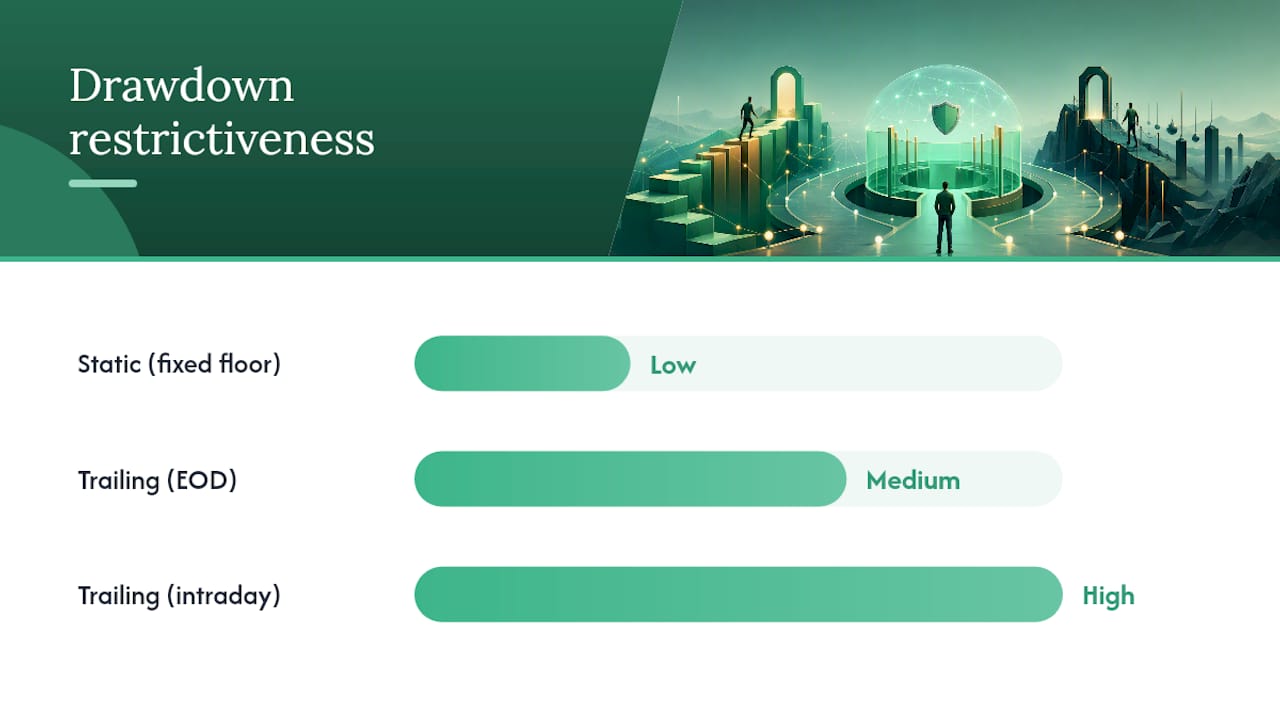
ResponsibleTrading notes that challenge entry costs start from around $13 and profit splits can reach up to 100% depending on the model. The wide range means the headline numbers are almost meaningless without knowing the drawdown type underneath them. A 100% split with intraday trailing drawdown is a harder target than an 80% split with static drawdown for most CFD strategies.
Fee math example: A $200 entry fee for a $10,000 funded account is a 2% cost. If you expect a 30% pass rate across attempts, your effective cost per funded dollar is closer to 6.7 cents per $1 of capital. Factor that into your expected profit before you commit.
Are CFDs legal for US traders, and what are the alternatives?
Direct retail CFD trading is restricted in the United States. The CFTC and NFA prohibit most US-based brokers from offering over-the-counter CFDs to retail clients. This is not a gray area: it is a structural restriction that has been in place for years, and it affects which prop firm accounts you can legally open and fund.
That said, "CFD prop firm" is a broad label, and not every firm using it is offering products that fall under CFTC jurisdiction. Here is how to think through your options:
- Futures (CME-listed): Fully legal for US residents. ES, NQ, CL, and GC futures give you leveraged exposure to indices, energy, and metals with full regulatory clarity. Futures-specialist prop firms are built around these instruments.
- Forex through regulated US brokers: Spot forex is available to US residents through NFA-registered brokers, though leverage is capped at 1:50 for major pairs and 1:20 for minors. Some prop firms offer forex-only accounts that comply with this structure.
- Stock CFDs via non-US accounts: Some global prop firms offer stock CFDs to non-US account holders. US residents who attempt to access these accounts through offshore structures carry legal and tax risk. This is not a recommended path without qualified legal advice.
- Listed ETFs and options: For index and commodity exposure, listed ETFs and options on US exchanges are fully compliant alternatives that replicate much of the economic exposure of CFDs.
Practical verification steps for US traders
- Read the firm's terms of service for explicit US residency exclusions. Look for language like "not available to residents of the United States" in the eligibility section.
- Contact support and ask for written confirmation of US acceptance before paying any fee.
- Prefer firms with broker-backed or US-cleared execution when possible. These structures are more likely to have gone through compliance review for US clients.
- Understand your tax reporting obligations. Funded trading profits are generally taxable income in the US, and the treatment varies by instrument. Mixfunded's prop firm tax guide covers the key reporting considerations for funded traders.
Pro Tip: If a firm's terms of service do not mention US residents at all, that silence is not permission. Ask directly, document the response, and keep that record in case of a dispute.
A closer look at each prop firm category
Benzinga's use-case picks and PropNavi's trust-based ranking both emphasize that the best firm depends on your trader profile, not a universal ranking. Here is how each category maps to real trader needs.
Mixfunded: marketplace with on-chain payouts
Best for: Low-cost entry, payout transparency, and flexible strategy rules.
Mixfunded runs evaluations starting at $5, which is the lowest documented entry point in the market. Funded accounts support MT4 and MT5, allow EAs and algorithmic strategies, and carry no consistency rules or news trading restrictions. Payouts are weekly in USDT (TRC-20), settled on-chain and publicly verifiable through the public payout ledger. Scaling plans reach up to $2M in simulated capital. US eligibility should be confirmed directly with Mixfunded before entering a challenge, given the CFTC restrictions.

Two-phase forex/CFD challengers: FTMO, The5ers, FundedNext
Best for: Traders who want a structured two-phase evaluation with established payout records.
FTMO, The5ers, and FundedNext are among the most cited names in independent reviews. They offer two-phase evaluations with documented payout histories, MT4/MT5/cTrader support, and profit splits in the 75–90% range. US eligibility varies: FTMO restricts US residents from certain account types; The5ers and FundedNext have their own eligibility policies that you must verify directly. None of these firms should be assumed to accept US residents for CFD accounts without written confirmation.
Instant-funding providers: BrightFunded, Apex Trader Funding
Best for: Traders who want immediate access to a funded account without a multi-phase evaluation.
BrightFunded offers instant-funded accounts with no challenge phase, which suits traders confident in their consistency. Apex Trader Funding is primarily a futures-focused instant-funding firm, making it one of the cleaner options for US residents who want fast access without CFD ambiguity. Both firms apply tighter drawdown limits than two-phase challengers to offset the reduced evaluation barrier.
Broker-backed and subscription firms: Topstep, My Funded Futures
Best for: US residents who want full regulatory clarity and futures-based instruments.
Topstep and My Funded Futures operate on subscription models with CME-listed futures. Both are fully available to US residents, use Rithmic and Tradovate for execution, and offer documented scaling paths. Profit splits run 80–90% after the first payout. These firms are the most straightforward choice for US traders who want to avoid CFD eligibility questions entirely.
Multi-asset challengers: Funded Trading Plus
Best for: Traders who want broad asset coverage across forex, indices, commodities, and crypto.
Funded Trading Plus offers multi-asset accounts with MT4/MT5 support and profit splits up to 90%. US eligibility follows the same pattern as other global CFD challengers: verify directly before paying. The firm's scaling plan and drawdown rules are published in its rulebook, which is a positive transparency signal.
Pro Tip: Check the PropNavi ranking and LuxAlgo's CFD prop firm comparison side by side. PropNavi weights payout history and regulatory standing; LuxAlgo surfaces user-reported data. Together, they give you a cross-referenced view that neither alone provides.
How do you verify a prop firm's payouts and transparency?
Screenshots of payouts are not proof. A firm can publish any image it wants. Verifiable evidence requires a different standard, and the steps below give you a reproducible process.
- Check the public payout ledger. A firm with on-chain payouts publishes wallet addresses and transaction hashes. Copy a transaction hash and verify it independently on a blockchain explorer (e.g., Tronscan for TRC-20 transactions). If the hash resolves to a real transaction with the correct amount and timestamp, the payout is verified. Mixfunded's transparency report documents this process.
- Cross-reference independent aggregators. PropNavi evaluates firms on operating record, continuous public payout proofs, and regulatory standing. Track360 aggregates on-time payout rates across firms. Use both to cross-check any firm's self-reported payout claims.
- Sample payout cadence. Ask in community forums (Discord, Telegram, Reddit) whether payouts arrive on the advertised schedule. Look for patterns across multiple traders, not individual reports. One delayed payout is noise; a pattern of delays is a signal.
- Read the terms of service for payout conditions. Some firms include clauses that allow them to delay or deny payouts if they determine a strategy was "exploitative" or violated undisclosed rules. These clauses are a red flag if they are vague or appear only in the fine print.
On-chain payouts in USDT (TRC-20) provide a fundamentally different level of verification than bank transfers or screenshots. Every transaction is timestamped, publicly visible, and immutable. When a firm publishes on-chain proof, you can verify the payout yourself in under two minutes without trusting the firm's word. Mixfunded explains how on-chain settlement works and why weekly cadence reduces the gap between earning and receiving profits.
Red flags that indicate payout problems:
- Payout delays that exceed the firm's stated timeline by more than 48 hours, repeatedly
- Ledger entries that do not match the amounts traders report receiving
- Terms of service that define "prohibited strategies" after a trader has already passed the challenge
- Support responses that cite "compliance review" without a defined resolution timeline
How this comparison was built
The shortlist and category comparisons in this article were built on the following criteria and sources:
- Selection criteria: payout reliability (on-time rate and verifiable proof), rule transparency (machine-readable rulebook, no hidden clauses), asset and platform coverage, US eligibility documentation, community-reported experience, and operating history
- Primary evidence sources: PropNavi's trust-based ranking, Track360's aggregated payout data, TradingPilot's comparison filters, Benzinga's use-case roundup, ResponsibleTrading's fee and split overview, LuxAlgo's CFD prop firm page, and Mixfunded's published transparency materials
- Update cadence: This comparison reflects data available as of mid-2026. Firm rules, fees, and eligibility policies change frequently. Verify current terms directly with each firm before committing capital.
What most traders get wrong when vetting prop firms
The pattern that shows up most consistently when traders report bad experiences with prop firms is not picking the wrong profit split. It is skipping the eligibility and payout verification steps because the marketing looked credible.
A firm with a polished website, a Discord with thousands of members, and a headline profit split of 90% can still have a payout process that takes six weeks and requires you to navigate three support tickets. The transparency signals that actually matter are boring: a public ledger you can verify yourself, a rulebook you can read in one sitting, and a payout history that holds up across independent sources.
For US traders specifically, the CFD eligibility question is not a technicality. It determines whether you can legally withdraw profits from the account you just funded. Getting that answer wrong costs you the challenge fee at minimum, and potentially more if you have already built a profit balance you cannot access.
The practical tip worth applying before your first funded account: treat your first payout as a test, not a windfall. Request a small withdrawal immediately after you qualify. If it arrives on time and through the stated method, you have confirmed the process works. Then scale. If it does not, you have learned something important before you have a large balance at stake.
Mixfunded offers a transparent starting point for funded traders
If you have been comparing prop firm options and the eligibility questions, hidden rules, and payout uncertainty feel like the real obstacles, Mixfunded is built to remove exactly those friction points.

Evaluations start at $5, which means you can test the process, the platform, and the payout mechanics without a significant upfront commitment. MT4 and MT5 are both supported, EAs are permitted, and there are no consistency rules or news trading bans to navigate around. Payouts go out weekly in USDT (TRC-20), settled on-chain and verifiable on the public ledger by anyone with a blockchain explorer. Scaling plans reach up to $2M in simulated capital for traders who grow their accounts consistently.
US traders should confirm eligibility for CFD accounts directly with Mixfunded before entering a challenge, given the CFTC restrictions on retail CFDs. The Mixfunded Academy also covers tax and reporting considerations for funded traders in the US.
Start with the funded trading account page to review current evaluation options and confirm which account types are available in your jurisdiction.
Sources
- Best Prop Trading Firms — 2026 Trust-Based Ranking | PROP NAVI
- Best Prop Trading Firms 2026: 12 Firms on 10 Criteria
- Compare the Best Prop Trading Firms with TradingPilot
- Best Prop Trading Firms 2026: 12 Firms on 10 Criteria (Benzinga)
- Best Prop Firms 2026 — Ranked & Reviewed | Responsible Trading