Consistency Rules at Prop Firms: Calculate, Fix, and Avoid Breaches

The consistency rule caps how much of your total profit a single trading day can represent. Trip it, and your payout gets delayed, not your account closed.
Here is what you need to know immediately:
- Typical thresholds: 30%–50% of total net profit, with 40% being the most common value across evaluation and payout checks in 2026.
- Consequence: A breach holds your payout until additional modest wins dilute the ratio. Your account stays open.
- Immediate action: Stop requesting a payout. Calculate how much more profit you need, then trade for it with controlled position sizes.
The rule exists at the payout stage, the evaluation stage, or both, depending on the firm. Knowing which stage applies to you changes everything about how you manage your trading calendar.
Key Takeaways
The consistency rule is a payout-gating filter, not an account-closing penalty. Knowing the formula and your firm's denominator lets you manage the ratio proactively rather than react to a blocked withdrawal.
| Point | Details |
|---|---|
| Core formula | (Best day profit ÷ total net profit) × 100 must stay at or below the firm's threshold. |
| Typical thresholds | Most firms set the cap between 30% and 50%; 40% is the most common value in 2026. |
| Consequence of breach | Payout is delayed, not forfeited; trade additional modest wins to dilute the ratio. |
| Fix calculation | Required total profit = best day ÷ threshold; subtract current total to find the gap. |
| Mixfunded alternative | Mixfunded enforces no consistency rule on funded accounts, with weekly on-chain USDT payouts and up to 80% profit share. |
Table of Contents
- How do you calculate the consistency rule at a prop firm?
- Worked examples: pass vs. breach and the fix
- When and where does the consistency rule actually apply?
- Why do prop firms use consistency rules?
- What to do after a consistency breach: a recovery checklist
- How to vet a prop firm's consistency rule before you sign up
- How Mixfunded approaches consistency rules
- What trading without a consistency rule actually means for your psychology
- Mixfunded: a funded account without the consistency math
- The consistency rule rewards patience, not just skill
- Sources
How do you calculate the consistency rule at a prop firm?
The canonical formula is:
Consistency % = (Best Day Profit ÷ Total Net Profit) × 100
Your result must be at or below the firm's threshold.
Step-by-step calculation
- Identify your best single trading day. This is the highest net profit recorded on any one calendar day within the measurement window.
- Sum your total net profit. Add all daily P&L figures for the period. Losing days reduce this number, which is why a single bad week after a big day can make the ratio worse, not better.
- Divide best day by total net profit. Keep the result as a decimal.
- Multiply by 100 to express it as a percentage.
- Compare to the firm's threshold. If your percentage exceeds the cap, you are gated until you dilute it.
Edge cases that change the math
The denominator is where firms diverge most. Some firms compute consistency against positive-days' profit only, meaning losing days are excluded from the denominator entirely. That makes the ratio harder to pass because your total is smaller. Others use gross profit before commissions, or compare your best day against the account's profit target rather than your actual earned profit.
Payout-window resets also matter. Many firms reset the consistency clock after each approved withdrawal, so the measurement window starts fresh. If your firm resets, a large day early in a new window is far more dangerous than the same day late in a window where you have already built up a cushion of smaller wins.
Online consistency calculators typically ask for three inputs: best-day profit, total profit, and the firm's threshold. They return your current percentage and the additional profit needed to reach compliance. Running the numbers before you request a payout takes about 30 seconds and can save you weeks of waiting.
Worked examples: pass vs. breach and the fix
Example 1: $1,500 best day, 50% threshold
- Best day: $1,500
- Total net profit: $4,000
- Consistency %: ($1,500 ÷ $4,000) × 100 = 37.5%
- Result at 50% threshold: Pass
- Result at 30% threshold: Breach
Example 2: $2,000 best day, 40% threshold
- Best day: $2,000
- Total net profit: $4,500
- Consistency %: ($2,000 ÷ $4,500) × 100 = 44.4%
- Result at 40% threshold: Breach
The fix formula: Required total profit = Best day ÷ Threshold
For Example 2: $2,000 ÷ 0.40 = $5,000 required total profit
You currently have $4,500, so you need an additional $500 in net profit from modest, consistent days before requesting a payout. The corrective algebra is simple arithmetic that any trader can run in a spreadsheet.
Threshold comparison for a $2,000 best day
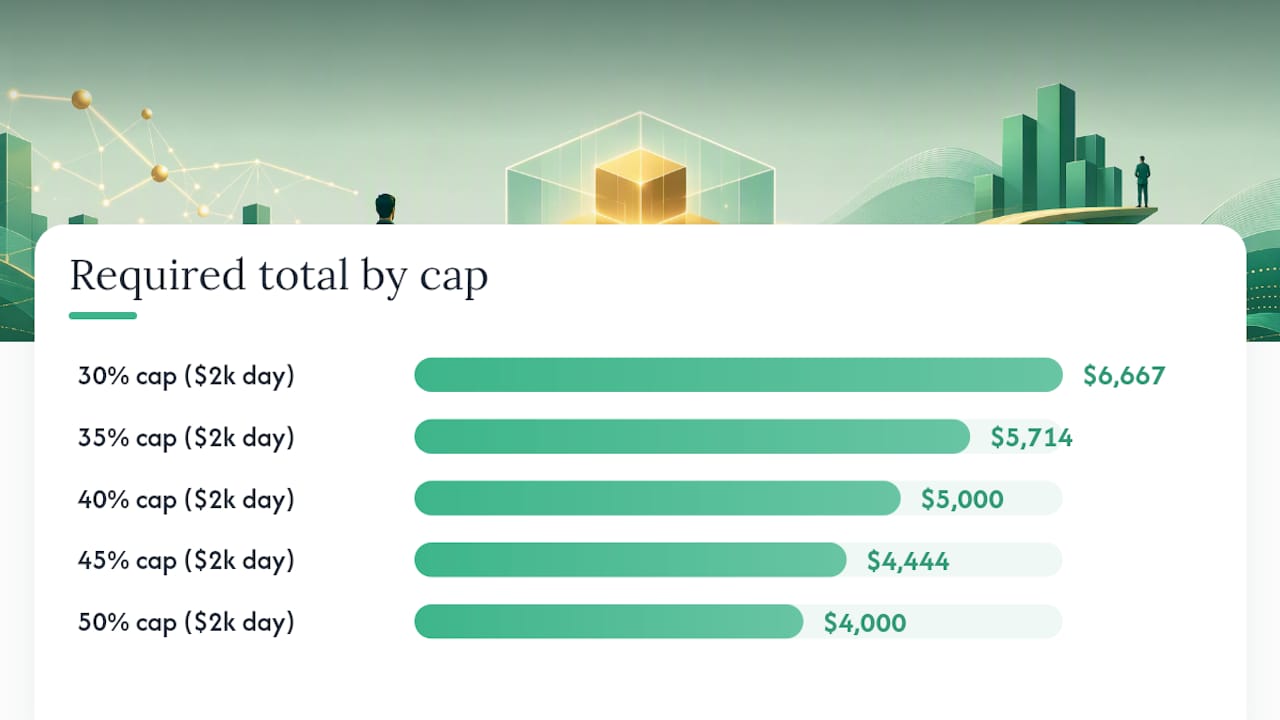
It requires four times the total profit to clear the same best day. That gap compounds quickly when your best day was unusually large.
Quick behavioral fixes when you are close to a breach:
- Wait before submitting a payout request; let a few more trading days accumulate.
- Add modest, smaller wins across multiple sessions to raise the denominator.
- Avoid high-conviction, oversized trades until the ratio is comfortably below the cap.
- Use a risk calculator to size positions so no single day can dominate your total again.
When and where does the consistency rule actually apply?
Firms vary considerably in which stages trigger a consistency check. Understanding the timing is as important as understanding the formula.
Common application points:
- During the evaluation challenge: Some firms check consistency at the end of the challenge phase. If your best day is too large relative to your total challenge profit, you may fail the evaluation outright or be required to keep trading before passing.
- At payout request: The most common application. The firm runs the calculation when you submit a withdrawal. If you breach, the payout is held until you dilute the ratio.
- On funded accounts: A smaller number of firms carry the rule into the funded phase. This is the most restrictive version because it affects real profit splits, not just evaluation passage.
Variants beyond the percentage cap:
- Minimum profitable days: Some firms require a minimum number of profitable trading days (commonly 3–10 active days), rather than a percentage cap. The practical effect is similar but the math is different.
- Single-trade caps: A few programs limit how much profit a single trade can contribute, independent of the daily total.
- Best-day-only checks: The firm looks only at whether any single day exceeds a fixed dollar amount, not a ratio.
After an approved payout, many firms reset the consistency window. Your next measurement period starts fresh, which means the first few days of a new window carry the highest ratio risk. Plan your largest trades for mid-window, after you have built a base of smaller profitable sessions.
Why do prop firms use consistency rules?
From the firm's perspective, consistency rules are underwriting filters. Before paying out a profit split on simulated capital, the firm wants evidence that the performance is repeatable, not a single lucky trade that happened to hit during the evaluation window.
One big day looks identical to luck from the outside. A firm cannot distinguish between a trader who caught a news spike on one position and a trader who runs a disciplined edge across dozens of sessions. The consistency rule forces the latter to be visible before a payout is approved.
This logic aligns with how the rule interacts with other protections. Drawdown limits cap the downside. Minimum trading-day requirements prevent traders from passing on a single session. The consistency rule addresses the upside equivalent: it prevents a trader from passing on a single outsized day. Together, these rules create a performance profile that looks more like a sustainable edge than a coin flip.
U.S. traders should also note that payout mechanics and contract disclosures interact with regulatory obligations when trading regulated instruments. The NFA's disclosure materials are worth reviewing alongside any funded account agreement to understand how contract-level terms apply to your specific situation.
What to do after a consistency breach: a recovery checklist
A breach is not a crisis. It is a math problem with a known solution. Here is a structured recovery plan.
- Stop all payout requests immediately. Submitting while in breach wastes time and may trigger a manual review at some firms.
- Run the fix formula. Divide your best day by the threshold to find the required total profit. Subtract your current total to find the gap.
- Set a daily profit target for the recovery period. Divide the gap by the number of trading days you plan to use. Keep each day's target well below the consistency cap so no new day becomes the new "best day."
- Trade with reduced position sizes. This is not the time for high-conviction setups. Modest, repeatable wins are the goal.
- Track your ratio daily. Recalculate after every session. You want to see the percentage dropping steadily.
- Submit the payout only when you are comfortably below the threshold. "Comfortably" means at least 3–5 percentage points of buffer, not right at the line.
- Contact support if the breach is ambiguous. If you believe the firm's calculation is using a denominator you did not expect (positive-days only vs. net profit), ask for clarification in writing and keep a record.
Pro Tip: Set a personal consistency cap 5–10 percentage points tighter than the firm's official threshold. That buffer absorbs a strong day without triggering a gate.
Breaking a consistency rule is typically a soft breach: profits are held, not confiscated. Traders recover eligibility by booking additional qualifying profit that lowers the best-day share. The recovery timeline depends entirely on how large the gap is and how consistently you can produce modest winning days.
How to vet a prop firm's consistency rule before you sign up
Reading the rulebook before you fund an account is the single most effective risk-management step you can take. Here is what to look for.
Vetting checklist:
- Exact threshold percentage. Is it 30%, 40%, 50%? Get the number, not a vague description.
- Denominator used. Net profit, positive-days profit, or profit target? This changes the calculation materially.
- Stage(s) where it applies. Evaluation only, payout only, or both? Does it carry into funded accounts?
- Reset behavior. Does the window reset after each approved payout? After a set number of days?
- Legacy vs. new-account rules. Thresholds can change. Some firms have moved thresholds (for example, reported changes in early 2026 affecting legacy versus new accounts), so confirm which version applies to your account.
Red flags to watch for:
- Vague wording like "reasonable consistency" with no defined percentage.
- Discrepancies between the help center article and the Terms and Conditions document.
- No mention of what happens to profits during a breach (are they held, forfeited, or simply delayed?).
- Retroactive rule changes with no grandfathering clause for existing accounts.
Sample phrases to search in the firm's T&Cs:
- "best day," "single day," "daily profit cap"
- "consistency percentage," "consistency ratio"
- "payout eligibility," "withdrawal conditions"
- "positive trading days," "minimum trading days"
Performance tracking tools like Ciphora can help you monitor your daily P&L distribution and flag when a single session is starting to dominate your running total, before you hit the firm's threshold.
How Mixfunded approaches consistency rules
Mixfunded does not enforce a consistency rule on funded accounts. That is a deliberate policy choice, and it has direct consequences for how you trade and when you get paid.
What Mixfunded offers:
- No consistency requirement on funded accounts. A strong day does not gate your payout.
- Challenge entry from $5, making it accessible to traders who want to test their edge without a large upfront commitment.
- Weekly payouts in USDT (TRC-20) on a public on-chain ledger, so every transaction is verifiable.
- Up to 80% profit share on funded account earnings.
- MT4/MT5 compatibility and support for EAs and flexible strategies, including news trading.
- Scaling plans up to $2 million in simulated capital for traders who build a track record.
The public payout ledger is a meaningful trust signal. You can verify that payouts are being processed before you commit to a challenge.
As with any funded program, read the full Terms and Conditions before trading. Mixfunded's trading rules page lists all current requirements in plain language. U.S. traders evaluating any funded account that involves regulated instruments should also review the relevant NFA disclosure materials alongside the firm's contract.
What trading without a consistency rule actually means for your psychology
Removing the consistency rule changes how you think about your best days. Under a ratio-based system, a strong session creates a problem: it raises the bar for everything that follows. Traders often describe pulling back after a big day not because the market is unfavorable but because they are managing a math constraint rather than a trading edge.
That behavioral distortion is real and underappreciated. Position sizing, trade selection, and session timing all get bent around the consistency calculation rather than around market opportunity. A firm that removes the rule lets you trade the market as it presents itself.
Mixfunded: a funded account without the consistency math
If the consistency rule is the part of prop trading that frustrates you most, Mixfunded is worth a direct look. The funded trading account starts at $5 to enter, pays weekly in USDT on a public blockchain, and carries no consistency requirement on funded accounts. Your best day is just your best day.

The challenge programs are designed to evaluate real trading skill without layering in rules that penalize strong performance. Check the current program options and entry costs at Mixfunded's challenges page, and verify the full rulebook before you start.
The consistency rule rewards patience, not just skill
The conventional advice on consistency rules focuses almost entirely on the math: calculate your ratio, find the gap, trade it down. That advice is correct but incomplete.
What most explainers miss is that the consistency rule is also a behavioral test disguised as an arithmetic one. The firm is not just checking a number. It is checking whether you understand that one strong session does not define a sustainable edge.
The traders who handle consistency rules best are the ones who never let the ratio get close to the cap in the first place. They size positions so that even their best day lands well inside the threshold. They treat the consistency percentage as a live metric, not an afterthought before a withdrawal. That discipline compounds over time in ways that pure P&L management does not.
Where the conventional advice genuinely falls short is in explaining what to do when the rule itself is poorly designed. Opaque denominators, retroactive threshold changes, and inconsistencies between a firm's help center and its T&Cs are not edge cases. They happen. The right response is not to accept the ambiguity but to ask for written clarification before you trade, not after a payout is blocked.
If a firm cannot clearly explain its own consistency rule in plain language, that tells you something important about how it will handle disputes.
Sources
- The Consistency Rule Explained: How One Big Day Can Block Your Payout | PROP NAVI
- What Is a Consistency Rule in Prop Firms? (2026 Guide) | PropFirmPickr
- Consistency Rule Explained: Prop Firm Limits & Calculator
- Prop Firm Consistency Rule Definition, Types and Examples
- What Is the Consistency Rule in Prop Firms: Understand It Before It Costs You
- Nfa
Cross-check any specific percentage against the firm's own help center or Terms and Conditions before relying on it. Thresholds change, and the version that applies to your account may differ from what a third-party guide reports.