Pass Prop Firm Challenge: Risk-First 30–50 Day Plan

To pass a prop firm challenge reliably, treat the evaluation as a risk-management exam, not a profit race. Your edge matters less than your ability to protect capital while accumulating gains within the firm's ruleset. Most traders fail due to drawdown and daily-loss breaches, not because they lack a working strategy. That single fact should shape every decision you make from day one.
Three actions belong on your first day:
- Read the firm's full terms and conditions and extract four numbers: profit target, daily loss limit, maximum drawdown, and minimum trading days.
- Set personal daily and maximum drawdown buffers that are stricter than the firm's limits, not equal to them.
- Size every trade to risk 0.5–1% of the account, and do not deviate until you have at least ten sessions of validated data.
The firm's limits are the floor, not your operating target. Traders who treat a 5% daily loss cap as their personal stop are one bad session away from a breach. Your internal limit should sit at roughly 50% of the firm's daily loss cap before you ever place a trade.
Pro Tip: Write your three non-negotiables on paper before opening the platform: your session window, your maximum trades per session, and your risk-per-trade. Treat them as contract rules, not suggestions.
Table of Contents
- What should you do before paying for a prop firm evaluation?
- How do prop firm evaluation rules actually work?
- How do you size positions for $25k, $50k, and $100k accounts?
- What should your strategy look like in each phase of the challenge?
- What metrics should you track in your trade journal?
- Your practical 30–50 day plan to pass the challenge
- How do you choose the right firm for your trading style?
- How does Mixfunded's model align with passing the challenge?
- What do you do after you pass? Submission and onboarding checklist
- What real challenge journeys look like: two common scenarios
- Key Takeaways
- What consistently funded traders do differently
- Mixfunded offers a transparent, low-cost path to a funded account
- Further reading and sources
What should you do before paying for a prop firm evaluation?
Skipping this checklist is the most common reason traders pay twice. Complete every item before you buy.
- Extract the four governing numbers. Read the actual T&Cs, not a summary page. Pull out the profit target percentage, daily loss limit, maximum drawdown, minimum trading days, and any consistency rule. Some firms' funded-phase rules differ from the evaluation phase, so read both.
- Run a demo under the firm's exact ruleset for 2–4 weeks. Simulate the challenge conditions precisely: same account size, same daily cap, same drawdown limit. If your strategy cannot hit the profit target on a demo without breaching rules, it will not do so live.
- Calculate your position size and set internal limits. Your personal daily stop should sit at roughly 50% of the firm's daily loss cap. Experienced traders consistently recommend this buffer to absorb variance without touching the firm's hard limit.
- Decide on one market, one session, and one primary setup. Narrowing your scope before day one removes ambiguity during the challenge. Fewer decisions under pressure means fewer mistakes.
- Prepare your tools. At minimum: a trade journal with emotional-state tags, a real-time drawdown monitor, and a pre-trade checklist you review before every session.
Pro Tip: Check whether the firm's drawdown is calculated from your starting balance, your peak equity, or your end-of-day equity. That single distinction changes your entire intraday risk model.
How do prop firm evaluation rules actually work?
Phase-based pacing and rule compatibility with your edge are essential to pass reliably. Before you can pace yourself, you need to understand exactly what each rule measures and how it can eliminate you.
Consistency rules and minimum trading days
Some firms cap how much of your total profit can come from a single day, often 30–40% of the overall target. If your profit target is $8,000 and the consistency cap is 30%, no single day's gain can exceed $2,400. A trader who hits $5,000 in one session may technically be close to the target but still disqualified.
Minimum trading days create a different trap. If the firm requires 10 trading days and you reach the profit target on day 6, you must keep trading without breaching any rule for four more days. Finishing fast is not always an advantage. The first two trading days carry a disproportionately high breach rate because traders oversize out of excitement. Slowing down early protects the account during its most vulnerable window.
News and overnight rules
Many firms restrict trading during high-impact news events or prohibit holding positions overnight. Check the news trading policy before you design your strategy. A news-based setup that works on a standard account may be explicitly banned during the evaluation.
Key insight: Firms design these rules to test whether you can manage risk under constraint. Understanding how prop firms make money clarifies why the rules are structured the way they are.
How do you size positions for $25k, $50k, and $100k accounts?
Position-sizing discipline is the single largest determinant of surviving a challenge. The core formula is straightforward:
Position size = (Account balance × Risk per trade %) ÷ Stop distance in dollars
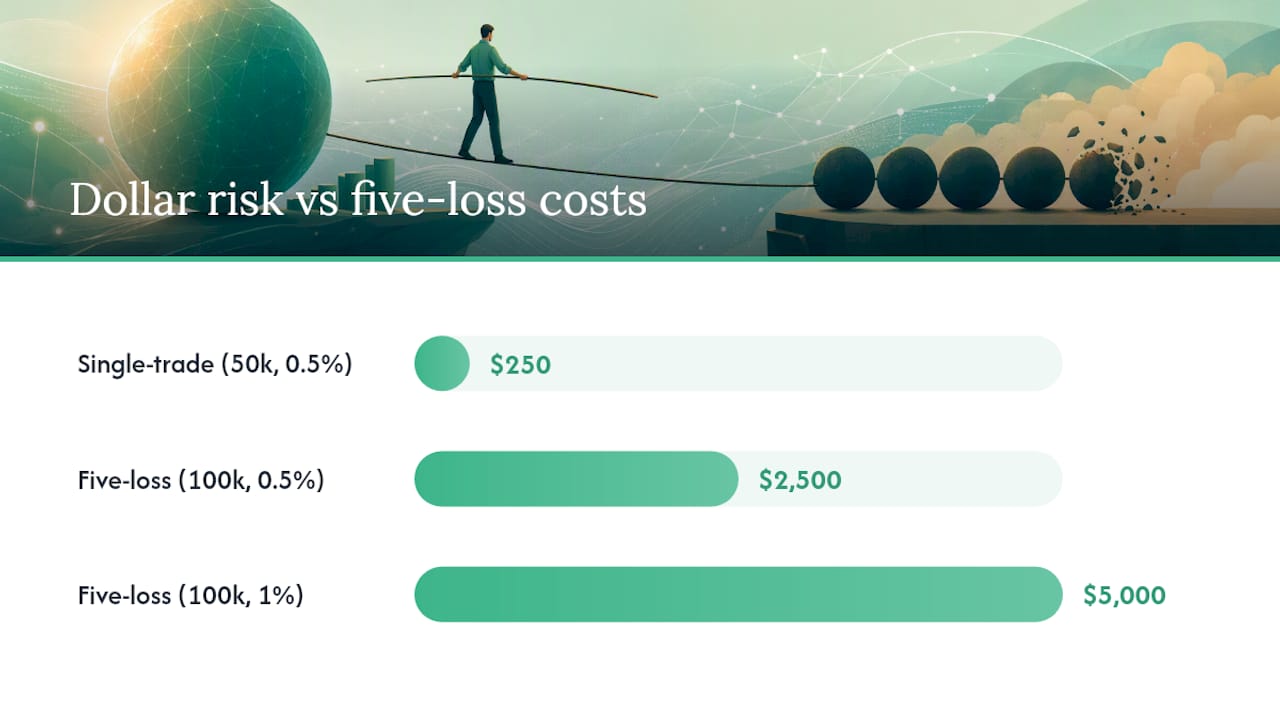
For a forex example: on a $50,000 account risking 0.5% with a 20-pip stop on EUR/USD (pip value ≈ $10 per standard lot):
- Dollar risk = $50,000 × 0.005 = $250
- Lots = $250 ÷ (20 pips × $10) = 1.25 lots
The table below shows how risk-per-trade translates across account sizes and what a five-loss streak costs you relative to a 10% maximum drawdown.
| Account | Risk/Trade | $ Risk | 5-Loss Streak | Max Drawdown Used |
|---|---|---|---|---|
| — | 0.5% | — | — | — |
| — | 0.5–1% | $250 | — | — |
| $50,000 | 0.5% | $250 | — | — |
| $50,000 | 0.5–1% | — | $2,500 | — |
| $100,000 | 0.5% | — | $2,500 | — |
| $100,000 | 0.5–1% | — | $5,000 | — |
At 1% risk per trade, five consecutive losses on a $100,000 account consume exactly half your maximum drawdown. At 0.5%, the same streak uses only a quarter. That buffer is what keeps you in the game long enough to recover and reach the profit target.
Daily-loss budgeting works the same way. If the firm's daily cap is 5% ($5,000 on a $100,000 account) and your personal limit is 50% of that ($2,500), you can absorb five 0.5%-risk losses before hitting your personal stop. That is a realistic bad day, not a catastrophic one.
Pro Tip: For your first 3–10 sessions, trade at 50% of your intended size. Use that period to validate that the live conditions match your demo results. Scale only after you have confirmed your edge is intact under the firm's actual rules.
Use Mixfunded's risk calculator and drawdown simulator to run these scenarios before you open a single position.
What should your strategy look like in each phase of the challenge?
Most traders who pass do so in roughly 2–6 weeks when targeting 0.5–1% per day. The key is adjusting your behavior as the account progresses through three distinct phases.
Phase 1: Early orientation (0–40% of profit target)
Your only goal in this phase is to confirm that your setup works under the firm's live conditions. Trade at 50–75% of your intended size. Take only your highest-conviction setups. Do not chase missed moves. If you breach your personal daily limit on any day in this phase, stop immediately and review before the next session.
Phase 2: Mid-challenge survival (40–80% of profit target)
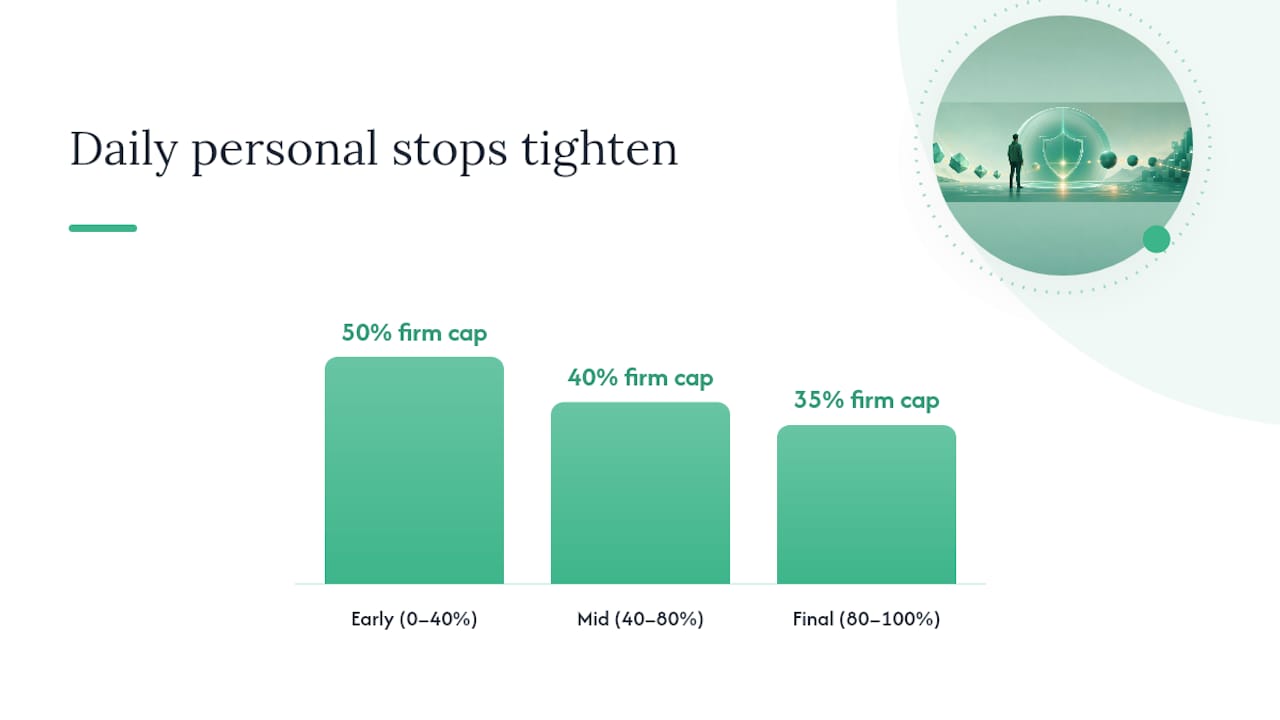
You have validated your edge. Now the priority shifts to protecting the buffer you have built. Maintain your standard risk-per-trade but tighten your daily stop to 40% of the firm's cap instead of 50%. Avoid adding new instruments or setups. This is not the phase to experiment.
Phase 3: Final stretch (80–100% of profit target)
Reduce size to 50–75% of your standard risk-per-trade. You need smaller, consistent gains to close the gap without risking a late-stage breach. One bad day at full size can erase a week of careful work.
| Phase | Profit Progress | Risk/Trade Target | Daily Stop (Personal) | Priority |
|---|---|---|---|---|
| Early | 0–40% | 50–75% of normal | 50% of firm cap | Validate edge |
| Mid | 40–80% | 100% of normal | 40% of firm cap | Protect buffer |
| Final | 80–100% | 50–75% of normal | 35% of firm cap | Close safely |
75% checkpoint: When you reach 75% of the profit target, review your drawdown usage. If you have consumed more than 40% of your maximum drawdown, reduce size immediately and do not increase it again.
90% checkpoint: At 90% of the target, switch to your smallest viable position size. The math is simple: the cost of failing here is the entire evaluation fee. The cost of taking two extra days to finish safely is nothing.
What metrics should you track in your trade journal?
A journal is only useful if it produces decisions. Track these fields for every trade:
- Timestamp, instrument, and session (London, New York, overlap)
- Setup tag (e.g., "trend pullback," "range breakout")
- Entry price, stop price, and target price
- Dollar risk on the trade
- Emotional state tag (calm, anxious, frustrated, confident)
- Outcome: win/loss, actual R achieved
Beyond individual trades, monitor these live metrics every session:
- Peak equity and current drawdown from peak
- Daily P&L versus your personal daily cap
- Consecutive losing trades in the current session
- Realized versus unrealized equity (do not count open positions toward your profit target)
- Profit-target progress as a percentage
The weekly review table below shows what threshold values should trigger a rule change.
| Metric | Review Trigger | Action |
|---|---|---|
| Drawdown used | >40% of max drawdown | Reduce size by 50% |
| Daily cap hit | Personal limit reached | Stop trading for the day |
| Consecutive losses | 2 in one session | End session immediately |
| Win rate (weekly) | Below 40% | Pause and paper trade |
| Profit progress | >90% of target | Switch to minimum size |
Emotional-state tracking in journals provides objective triggers to stop trading and prevents the behavioral drift that causes late-stage failures. When your journal shows three consecutive "frustrated" tags before a loss, that pattern becomes a rule: frustrated = no trade.
Use the Mixfunded Academy for structured guidance on reading challenge rules and building a journal framework that maps to the firm's exact ruleset.
Your practical 30–50 day plan to pass the challenge
-
Days 1–3 (Orientation). Trade at 50% of intended size. Take only your primary setup. Record every trade with full journal fields. Do not attempt to build profit. Goal: confirm live conditions match your demo results.
-
Days 4–10 (Validation). Increase to 75% of intended size if days 1–3 produced no rule breaches and your setup performed within expected parameters. Review your journal daily. Check drawdown usage every morning before the session.
-
Days 11–20 (Standard execution). Trade at full intended size (0.5–1% per trade). Follow the phase-based rules from Section 5. Apply the two-loss rule every session without exception.
-
Days 21–30 (Mid-challenge review). Conduct a full journal review. Calculate your profit progress, drawdown usage, and win rate. If any metric is outside acceptable range, reduce size and paper trade for two sessions before returning.
-
Days 31–40 (Final stretch). If you are at 80%+ of the profit target, switch to 50–75% of standard size. Track your minimum trading days. Do not add new setups or instruments.
-
Days 41–50 (Close safely). Minimum size only. One setup, one session per day. Stop the moment you hit the profit target and have met the minimum trading days.
Stop conditions:
- Personal daily limit hit: stop trading for the day, no exceptions.
- Drawdown usage exceeds 60% of maximum: reduce size by half and do not increase it for the remainder of the challenge.
- Win rate below 40% over any 10-session window: pause the challenge, paper trade for one week, then reassess.
- Two consecutive sessions hitting the personal daily stop: consider whether the strategy is misaligned with current market conditions before continuing.
Daily routine:
- Pre-session: check drawdown floor, set position size, mark news events, review journal from previous session.
- Intraday: stop after two consecutive losses; stop if personal daily limit is reached.
- End of day: log all trades with emotional tags, update profit-target progress, calculate next session's drawdown floor.
How do you choose the right firm for your trading style?
The right challenge is the one whose rules match your proven edge, not the one with the most attractive marketing. Verify the firm's rules before paying, and use this criteria checklist when vetting any firm's T&Cs.
Criteria checklist:
- What type of drawdown applies: static, intraday trailing, or EOD trailing?
- Is the daily loss limit calculated from the starting balance or the current balance?
- Is there a consistency rule, and what percentage does it cap per day?
- What is the minimum number of trading days required?
- Are EAs and automated strategies permitted?
- Are news trading and overnight holds allowed?
- What is the time limit for completing the evaluation?
- Do the funded-account rules differ from the evaluation rules?
Use the Mixfunded vetting guide to run this checklist against any firm before committing.
| Trading Style | Best Drawdown Type | Consistency Rule | EA Policy | News Trading |
|---|---|---|---|---|
| Swing trader | Static or EOD trailing | Flexible or none | Not critical | Avoid |
| Scalper | Static | Flexible or none | Preferred | Avoid |
| News/macro trader | Static | Flexible or none | Not critical | Must be allowed |
| Algo/EA trader | Static or EOD trailing | Flexible or none | Must be allowed | Firm-dependent |
Swing traders are most vulnerable to intraday trailing drawdown because positions that run in profit before reversing can permanently tighten the floor. Scalpers need tight spreads and a static drawdown so that small intraday fluctuations do not move their floor. Algorithmic traders must confirm EA allowance in writing before paying, since some firms restrict automation to specific hours or ban it entirely.
How does Mixfunded's model align with passing the challenge?
Mixfunded's product design maps directly to the pass-framework described throughout this guide. Here is how each feature connects to a concrete tactic.
- Transparent, published rules. Mixfunded publishes its full trading rules without hidden fine print. That transparency makes the pre-challenge checklist faster to complete because you are reading the actual ruleset, not a marketing summary.
- Weekly USDT (TRC-20) payouts with on-chain transparency. Every payout is publicly visible on the Mixfunded ledger. That transparency is a meaningful trust signal when you are deciding whether a firm will actually pay after you pass.
Pro Tip: Use Mixfunded's risk calculator to run the position-sizing worksheet from Section 4 against your specific account size and stop distances before day one. It takes five minutes and removes all guesswork from your sizing decisions.
What do you do after you pass? Submission and onboarding checklist
Passing the evaluation is a specific moment with specific steps. Do not skip any of them.
Submission checklist:
- Confirm you have met the profit target and the minimum trading days simultaneously.
- Verify no rule was breached at any point during the evaluation (check the platform's rule tracker, not just your journal).
- Close all open positions before submitting. Do not carry trades into the funded account without explicit permission from the firm.
- Take a screenshot or export of your full trading history, equity curve, and rule-compliance report.
- Submit the evaluation through the firm's official process and retain the confirmation.
Onboarding checklist:
- Read the funded-account T&Cs separately from the evaluation T&Cs. Rules often differ between phases.
- Confirm the payout schedule, payout method, and profit split percentage in writing before placing your first funded trade.
- Set up your funded account with the same internal limits you used during the evaluation. Do not increase risk just because you are now funded.
- Verify the drawdown type on the funded account. Some firms switch from static to trailing drawdown after the evaluation.
- Schedule your first payout request according to the firm's minimum holding period.
- Keep your trade journal running from day one of the funded account. The behavioral discipline that got you through the evaluation is what keeps the account alive.
What real challenge journeys look like: two common scenarios
These scenarios illustrate the decision points where traders succeed or fail. They are constructed from the behavioral patterns described throughout this guide, not attributed to specific individuals.
Scenario A: The controlled pass
A trader with a trend-pullback strategy on EUR/USD starts a $50,000 evaluation. Days 1–3 are at 50% size, producing three small winning sessions and one small loss. No rule is touched. By day 10, the account is at 35% of the profit target. The trader increases to full size (0.5% per trade) and maintains the two-loss rule strictly. On day 18, a frustration tag appears in the journal after a losing session. The trader stops for the day at the personal daily limit, not the firm's limit. By day 28, the profit target is reached with 60% of the maximum drawdown unused. The trader reduces to minimum size, completes the minimum trading days on day 32, and submits.
What made this work: the early slow start, the journal-driven stop on the frustration day, and the size reduction at 80% of the target.
Scenario B: The avoidable reset
A trader starts a $100,000 evaluation with a scalping strategy. Day 1 produces a strong session, and the trader doubles size on day 2 out of confidence. A news spike on day 3 triggers a 3% loss in one session, consuming 60% of the maximum drawdown in three days. The trader attempts to recover by increasing size further. By day 5, the maximum drawdown is breached and the evaluation is over.
The failure had nothing to do with the strategy. It came from ignoring the slow-start rule, skipping the news calendar, and abandoning the position-size discipline that the demo had validated. Every one of those errors was preventable.
Key Takeaways
Passing a prop firm challenge comes down to one discipline: protect capital first, accumulate profit second, and never treat the firm's hard limits as your personal operating targets.
| Point | Details |
|---|---|
| Risk-first execution | Size every trade at 0.5–1% of the account and set personal daily stops at 50% of the firm's cap. |
| Know your drawdown type | Static, intraday trailing, and EOD trailing each require a different intraday risk model — confirm yours before day one. |
| Phase your approach | Trade at 50–75% size in the early phase, full size in the mid phase, and reduced size again in the final stretch. |
| One setup, one session | Restricting to your highest-probability setup and session reduces variance and rule conflicts throughout the evaluation. |
| Mixfunded's fit | Mixfunded's no-consistency-rule, EA-allowed, on-chain payout model removes three of the most common disqualification triggers. |
What consistently funded traders do differently
The behavioral gap between traders who pass once and traders who pass repeatedly is narrower than most people expect. It is not about having a better strategy. It is about treating the evaluation as a separate operating environment with its own rules, and refusing to let normal trading habits bleed in.
The two-week demo validation rule is where most serious traders draw the line. If a strategy cannot produce consistent results on a demo running the firm's exact ruleset for two weeks, it is not ready for a paid evaluation. That sounds obvious. Most traders skip it anyway because they are confident in their live track record. The problem is that live trading and challenge trading are not the same activity. The rules change the math, and the math changes the behavior.
Journaling is the other separator. Not because writing things down is inherently valuable, but because a journal with emotional-state tags converts subjective feelings into objective data. When you can see that your worst sessions consistently follow a "frustrated" or "overconfident" tag, you have a rule: those states mean no trade. That rule is worth more than any technical setup.
The traders who pass consistently are not the ones with the best entries. They are the ones who stop when they are supposed to stop, size correctly from session one, and treat the evaluation's rules as non-negotiable constraints rather than guidelines to bend when conditions feel right.
Mixfunded offers a transparent, low-cost path to a funded account
If the framework in this guide matches how you want to trade, Mixfunded is built around the same principles. Challenges start at $5, the rules are published without hidden clauses, and every payout is recorded on-chain so you can verify it independently. There is no consistency rule to navigate and no news trading ban to work around. EAs are permitted, so you can automate the daily-loss shutdown and position-size cap that this guide recommends.

The funded trading account options scale from entry-level to $2 million, and weekly USDT payouts mean you are not waiting a month to see results. View the full challenge programs and run your sizing scenarios through the risk calculator before you start.
Further reading and sources
- Pass prop firm challenge — TradeZella
- How to Pass a Funded Challenge in Under 50 Days — RB Trading
- How to Pass a Prop Firm Challenge — PropFirmApp
- How to pass a prop firm challenge — FundedTraderIntel
- How to Pass a Prop Firm Challenge — TradingToolsHub
- How to Pass a Prop Firm Challenge: 10 Proven Strategies — ThePropFirmGuide
- How to Pass a Prop Firm Challenge — FundedWiki
- How to Pass a Funded Challenge Without Blowing It — R2F Trading